



In 2016, Roy Dreyfuss, an IT manager living in Greensboro, North Carolina, was dealing with some bad news. The Hodgkin lymphoma he had been diagnosed with almost two years before had returned after eight months of chemotherapy had initially put him into remission.
Dreyfuss was referred to UNC Health hematologist and oncologist Benjamin Vincent, MD, for his next step, an autologous stem cell transplant, also known as a bone marrow transplant. Dr. Vincent realized there was a new treatment in a clinical trial at UNC Health that might help Dreyfuss if it were paired with the transplant: CAR T-cell therapy, in which a patient’s own cells are trained to target cancer cells.
After some questions and consideration, Dreyfuss agreed, and on July 22, 2016—more than a year before the FDA approved this treatment for other blood cancers—Dreyfuss became the first patient to receive CAR T-cell therapy at UNC Health.
“You take a chance, but I was going to have the transplant anyway,” Dreyfuss says. “I just wanted a better chance of surviving after. I still have a lot of things I want to do.”
CAR T-Cell Therapy Gives New Hope to People with Blood Cancer
Chimeric antigen receptor (CAR) T-cell therapy was first approved by the Food and Drug Administration in August 2017, and it would go on to change the way blood cancer is treated, offering people who didn’t have any other treatment options a longer life or complete remission.
“When I started fellowship in 2011, leukemia, lymphoma and multiple myeloma all had vastly fewer treatment options,” Dr. Vincent says. “CAR T-cell therapy really was a revolution, with so many patients benefiting. It’s incredibly inspiring.”
As with any new treatment, the work to determine if CAR T-cell therapy was safe and effective began decades before, first in the laboratory and then in clinical trials. When UNC Health researchers saw the early results of CAR T-cell therapy at other institutions, they began investing in the facilities to manufacture cells and personnel needed to offer clinical trials in North Carolina.
That means they were ready to provide this emerging treatment to patients like Dreyfuss.
The Decision to Participate in a Clinical Trial
Dreyfuss was preparing for his autologous stem cell transplant, during which his own stem cells would be collected, frozen and then returned to his body after a higher-than-usual dose of chemotherapy, when he learned about CAR T-cell therapy from Dr. Vincent.
Dr. Vincent, who had been paying close attention to the research into CAR T-cell therapy and to the clinical trials being offered at UNC, thought one particular trial could potentially make the treatment more effective for Dreyfuss.
In this trial, CAR T-cell therapy would use a person’s own cells to target CD30, a protein found in cancerous cells in Hodgkin lymphoma, following a stem cell transplant, with the goal of making remission after a transplant last longer.
“I was a new faculty member, and I remember thinking how exciting it was to have a CD30 trial,” Dr. Vincent says. “It was a big deal in 2016 to have an in-house manufacturing facility so we could offer clinical trials for CAR T-cell therapies developed at UNC, and this was the first one to target CD30. People would fly across the country to be in this trial.”
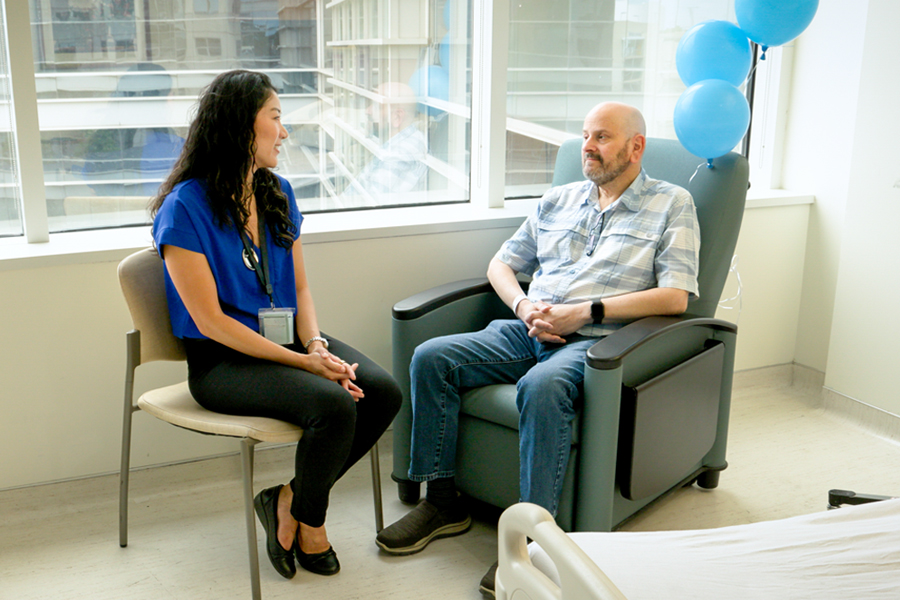
Dreyfuss met with Catherine Cheng, cellular therapy lead of UNC’s Clinical Immunotherapy Program, to learn more about what it would mean to participate in the first phase of a clinical trial. Dreyfuss had to agree to years of follow-up and was concerned about potential costs and time off from work.
“In any clinical trial, we walk patients through each part of their journey, and it can be scary when a trial is in phase 1, which in most cases are the first in-human trials, when we may not know what side effects people will experience,” Cheng says. “We want to make sure people understand what to expect, all the monitoring. There are many of us working to help patients and caregivers through every step.”
What Dreyfuss learned through his conversations with Dr. Vincent and Cheng made his decision easy, he says.
“I had never been a part of anything like this before, a study of any kind,” Dreyfuss says. “I found it intriguing, and I couldn’t believe how the medical science had advanced since the 1980s when my father had Hodgkin lymphoma.”
“A Day I Won’t Forget”
For CAR T-cell therapy, your blood is drawn and spun to separate out white blood cells called T-cells. These T-cells are then sent to a special lab—in this case, the UNC Advanced Cellular Therapeutics Facility in Chapel Hill—so that they can be specially engineered to fight a specific cancer element, such as CD30 in Dreyfuss’s case.
“Cellular therapy is one of the more complicated things we do in medicine, because every product is custom to the patient,” Dr. Vincent says. “That means people in the lab have to bring their competency and excellence. On the clinical side, there are navigators, nurses, pharmacists, providers all working with the patient for years. It takes everyone working together.”
All of that work culminated on July 22, 2016, when Dreyfuss, having received his stem cell transplant, was ready for the infusion of his modified T-cells. While other clinical trials were in progress, Dreyfuss was the first patient to receive a CAR T-cell therapy infusion at UNC.
“It was super exciting and groundbreaking, and we were just so happy for him to have this opportunity,” Cheng says. She happened to be celebrating her birthday that day, so she and Dreyfuss consider each other a special sort of “birthday twins.”
“It’s a day I won’t forget,” Dreyfuss says. “There was a whole crowd watching. I had my laptop and I just worked, because I didn’t want to take much time off. I wasn’t in pain.”
In fact, for Dreyfuss, the worst part of was that infusions can smell like tomato juice because of a chemical in the treatment. He hates tomato juice.
“That was the humor of the experience,” Dreyfuss says. “I’m in a gown with all of these people standing around, and boy, did it smell like tomato juice. I don’t like it. Never did.”
Dreyfuss says the first few days after the infusion were difficult, as he didn’t have the energy to even get out of bed, but that he felt more like himself after three weeks. His brother and sister came to North Carolina to care for him and drive him to his follow-up appointments.
Continued Care at UNC Health
In 2017, Dreyfuss’s lymphoma returned.
“The first phase of a clinical trial is usually not a cure. It’s a chance, because you get access to a drug that might not otherwise be available,” Dr. Vincent says. “Mr. Dreyfuss was the perfect candidate for a phase 1 trial, because he was motivated to be a part of advancing the science for others. With each clinical trial, we see what works and expand the tools we have against cancer.”
After having chemotherapy at UNC Hospitals, Dreyfuss needed an allogenic stem cell transplant, meaning that donor blood would have to be used rather than his own. Because he needed several months of caregiving, Dreyfuss asked Dr. Vincent to connect him with a treatment team in Connecticut so that he could stay with his brother for the transplant.
“As soon as I could, I hopped in the car and came back home to North Carolina,” Dreyfuss says. “UNC and Dr. Vincent have cared for me ever since.”
Recovery from this second transplant has not been easy. Because donor blood was used, Dreyfuss developed a severe case of graft-versus-host disease (GVHD), a complication in which the immune system overresponds to foreign cells. Though his cancer is controlled, Dreyfuss has dealt with increased infections in his lungs, severe dry eye and fatigue for years.
“He’s had a positive attitude through it all,” Dr. Vincent says. “I admire his spirit and persistence. It’s great to know him and work with him.”
Lessons Learned from 10 Years of CAR T-Cell Therapy
UNC Health’s CAR T-cell therapy program has celebrated many milestones since that first infusion in 2016.
“We’ve been able to extend our footprint and treat people from all over the world,” Cheng says. “The trials we’re conducting are possibly the only option that a patient has. This is their last try, but we can provide them with some hope.”
There is still not FDA approval for a CAR T-cell therapy for Hodgkin lymphoma, but clinical trials continue.
While CAR T-cell therapy has had the most success in treating blood cancers, both Cheng and Dr. Vincent are optimistic about the work being done with this therapy on solid tumors, such as breast, lung and head and neck cancer.
“Solid tumors obstruct this therapy and fight back in a way that blood cancers don’t. We haven’t had that big success yet, but there’s a lot of energy to try,” Dr. Vincent says. “Cellular therapy approaches in solid tumors will be the next big exciting thing.”
Cheng points to positive results in a CAR T-cell therapy clinical trial for glioblastoma, a type of brain tumor that typically causes death in 15 to 18 months.
“People with glioblastoma have very limited treatment options, but we’re seeing positive results in our patients,” she says. “Having someone live longer than what their diagnosis suggests—that’s really exciting.”
This continued work is possible because of patients like Dreyfuss.
His advice for people considering a clinical trial for cancer treatment? “Do not fear,” he says. “It’s an interesting experience, but at the end of the day, it’s also lifesaving. I’ve been very happy with my care and proud to be a part of this.”
If you have questions about cancer treatment, talk to your doctor. If you need a doctor, find one near you.