


Editor’s note: This is a developing story. On July 17, 2026, Taylor Farms initiated a recall of all iceberg lettuce sourced from central Mexico because of cyclospora infections linked to shredded iceberg lettuce in five states. Public health officials are investigating other possible sources.
You’re probably hearing a lot about an intestinal infection that causes days of explosive diarrhea, but cyclosporiasis isn’t new.
There were about 250 cases reported last summer, and outbreaks in 2019 and 1996.
But this summer tops them all. Since May 1, 2026, there have been 1,645 confirmed cases of cyclosporiasis and more than 5,100 likely cases of the infection in more than 30 states.
There will be more cases until all of the contaminated food sources are identified and because of the long incubation period of this parasite.
“Cases are rising faster than recent summers, and we’re still on the upswing,” says UNC Health infectious diseases expert David J. Weber, MD, MPH. “At this point, there’s no way to say if we’re going to have 1,000 or 10,000 more cases.”
There’s some good news: Cyclosporiasis is not transmitted person-to-person, and there is treatment available. Dr. Weber explains what you need to know about this infection and how to stay safe.
How Cyclosporiasis is Transmitted
Cyclosporiasis is caused by the parasite Cyclospora cayetanensis, which thrives in hot climates and is common in tropical and subtropical areas. Cyclospora must mature in soil or water, and the parasite can get into food through farming.
Historically, leafy greens, herbs, raspberries, blackberries, snow and snap peas and green onions are most often linked to cyclospora infections; these foods are often imported to the U.S. from warmer countries. It can also be in the tap water in countries that lack robust filtration systems.
When a person consumes infected food or water, the cyclospora burrows into a person’s intestine and multiplies, creating a form called oocysts. Oocysts leave the body via stool, but those oocysts aren’t infectious—they have to mature in soil or water. That’s the big difference between cyclosporiasis and norovirus, where stool itself is infectious and virus particles can spread more easily.
“If one person in your house gets sick with norovirus, everyone will,” Dr. Weber says. “This has to be in the soil for several days after it’s been in stool, so it does not go person to person.”
There is typically a delay between eating or drinking contaminated food or water and experiencing symptoms.
“It could be a range of two to 14 days before you see symptoms; the median time is seven days after eating something,” Dr. Weber says.
Symptoms of Cyclospora Infection
It’s possible to have no symptoms or only mild symptoms as a result of cyclospora infection, but if you do have symptoms, they’re going to be unpleasant.
“It causes explosive diarrhea—you’ll have the feeling that you have to go to the bathroom right away,” Dr. Weber says. “It’s watery, it’s voluminous, it can last for days to weeks.”
Other symptoms include headache, fatigue, fever and abdominal cramping.
The delay between consuming infected food and experiencing symptoms makes identifying all of the sources of the outbreak more difficult. With food poisoning, symptoms start within three to six hours of eating, making it easier to find a source. People are less likely to remember what they ate two weeks ago, and “nobody eats basil or lettuce by itself,” Dr. Weber says. “Even if we figure out it’s in a salad, we still have to figure out what part of the salad.”
This outbreak is also complicated by the complexity of the food system; while the 1996 outbreak was tied to five farms and three importers, the answer this time won’t be as simple, Dr. Weber says.
Cyclosporiasis Treatment and Complications
If you have a day or two of diarrhea that resolves and you’re able to stay hydrated, you don’t need to see your doctor, Dr. Weber says.
But if you’re on your third day of diarrhea, and you don’t have an underlying condition that could cause diarrhea, talk to your doctor about treatment. A seven- to 10-day course of the antibiotic trimethoprim-sulfamethoxazole (brand names Bactrim and Septra), taken twice a day orally, will resolve symptoms within a few days. You may not be able to take this specific antibiotic if you are pregnant; ask your OB-GYN about your options.
If you suspect cyclosporiasis, or any other particular infection, it’s better to seek the specific treatment rather than relying on over-the-counter options such as Pepto-Bismol or Imodium.
“For some toxins, you can slow down the process of it leaving your system, so it’s better not to stop things up,” Dr. Weber says.
While you’re waiting for symptoms to resolve, it’s important to stay hydrated. Dehydration is the major complication of cyclosporiasis, and the risk is especially high for babies, people older than 65 and people with compromised immune systems. People who are hospitalized with cyclosporiasis—as of now, the CDC is reporting 141 hospitalizations—are usually dehydrated and receive IV fluids.
If you notice symptoms of dehydration—decreased urination, dry mouth or lips, crying without tears, unusual sleepiness or lethargy, or skin changes—seek immediate care.
As of now, there have been no deaths from the 2026 outbreak of cyclosporiasis.
How to Prevent Cyclosporiasis
Health officials are tracking the foods that caused these infections. Look for product recalls communicated through news outlets, the CDC, the FDA and local health departments.
Until then, be very careful with the foods most known to cause cyclosporiasis—leafy greens, berries and fresh herbs.
“The cooked versions are fine,” Dr. Weber says, noting that heat can kill the cyclospora parasite. “It’s highly unlikely to be in local produce, so I think you could also go to a farmer’s market and buy local. You can also buy frozen versions.”
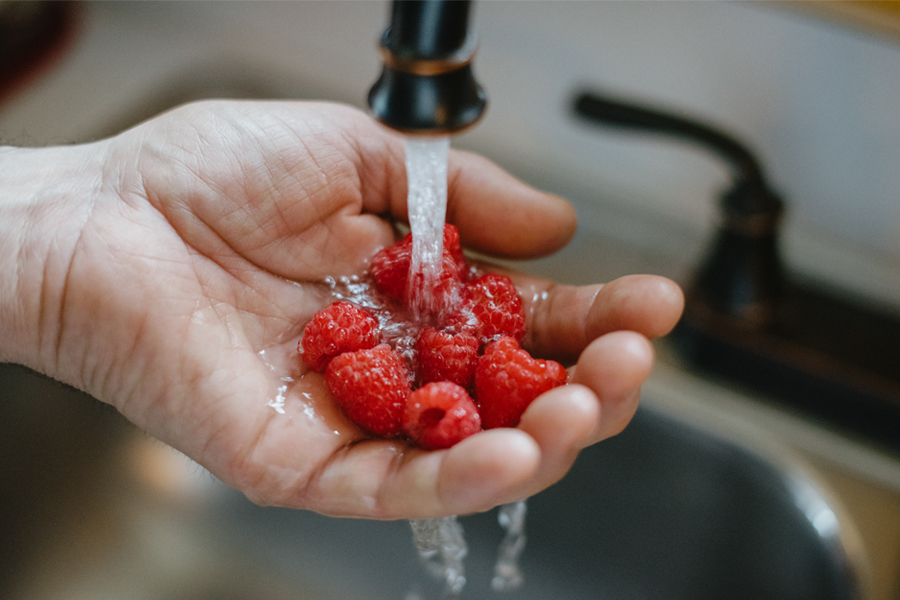
If you are eating greens, herbs or berries, rinse them vigorously in water.
“Water doesn’t kill the parasite; it needs to be physically removed,” Dr. Weber says. “So you can’t just put a head of lettuce under water—you need to rinse each piece and remove parts that look damaged.”
Disinfectants are unlikely to kill cyclospora, so there’s no need to add anything to the water when you wash produce.
If you’re traveling outside the United States, check whether you’re going to a country that recommends drinking bottled water to prevent traveler’s diarrhea.
“Tap water in the United States is not a problem because most plants filter their water through sand and trap the parasite,” Dr. Weber says. “It can be an issue in other countries, but I’m not worried about contaminated water in the U.S.”
If you’re having gastrointestinal problems, talk to your doctor or find one near you.