


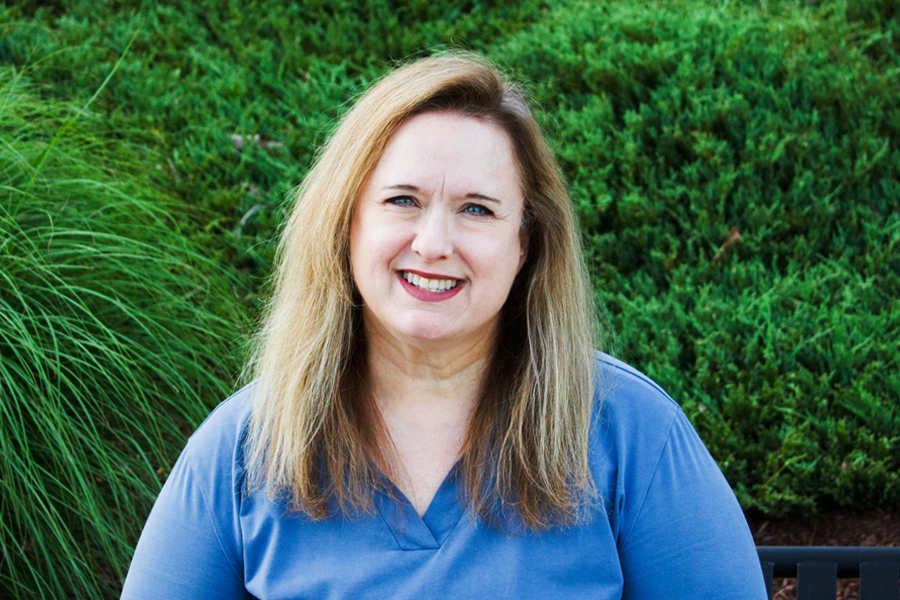
Chantal Weedman first experienced meralgia paresthetica, a nerve condition that causes numbness, tingling, burning and pain in the outer thigh, in 2022. Weedman, now 54, received a nerve injection which relieved the pain, though not the numbness, and moved on with her life.
But in 2025, the pain was back and unbearable.
“I experienced burning that felt like a blow torch to my thigh, or it would feel like I was being stabbed repeatedly with a knife,” Weedman remembers. “Periodically, I would have electrical impulses or shocks like I’d been tased. There was numbness, like the pins and needles you get when a limb goes to sleep and is waking back up. A piece of clothing touching my leg was torture.”
Weedman received another injection of medication, which didn’t help. Her doctor at the time told her that was her only option, to continue injecting the nerve. After some online research, Weedman found Mark Attiah, MD, a UNC Health neurosurgeon who specializes in the treatment of peripheral nerve disorders. Peripheral nerves connect the brain and spinal cord to the rest of the body.
“I told Dr. Attiah that I wasn’t a harm to myself, but that I did wonder why I should continue to live if this pain wouldn’t get better,” Weedman says. “That’s how much pain I was in. I have experienced acute pain because of injuries, but I’d never dealt with this kind of chronic pain. ‘Debilitating’ is not a strong enough word.”
Dr. Attiah was able to provide something that very few people with meralgia paresthetica are offered: a surgical option that would relieve the pain.
Typical Treatments for Meralgia Paresthetica
Meralgia paresthetica happens when the lateral femoral cutaneous nerve, a nerve that runs through the pelvis and groin to the front of the upper thigh, is pinched or compressed. That compression can happen because of pregnancy, obesity, diabetes or a trauma to the nerves, such as a car accident, fall or surgery. People who wear very tight clothing or heavy belts for their job (such as police officers or construction workers) and some athletes are at increased risk. Meralgia paresthetica affects between 3 and 4 people out of 10,000 people per year.
While the cause of Weedman’s meralgia paresthetica is not clear, it was made worse by overexertion; she was packing up her house to move when the pain returned in 2025. Weedman tried every recommended treatment.
“I was told that if I lost weight, the pain would go away,” Weedman says. “I was so nauseated from the pain that I stopped eating and lost 75 pounds. The pain only got worse.”
She was put on the maximum doses of oral pain medications, with no effect, and tried physical therapy, acupuncture and a transcutaneous electrical nerve stimulation (TENS) device, which relieves pain by blocking nerve signals to the brain. Nothing worked, and Weedman found it difficult to sleep or walk, which made her work as a business operations manager at Cisco and caring for her aging mother very difficult.
Weedman’s neurologist at the time could only offer more nerve block injections, which she didn’t want to pursue if they weren’t working. Weedman was a member of several online forums for people who suffer from meralgia paresthetica, so she knew how difficult it would be to find someone who would offer a surgical option.
As it turned out, a surgeon experienced in these types of nerve surgeries was available very close to Weedman’s home in Garner, North Carolina.
“There is a lack of knowledge and expertise in peripheral nerve surgeries, so even providers don’t know it’s an option,” Dr. Attiah says. “If injections or conservative management works for meralgia paresthetica, that’s great, but if you can’t live with this pain, then decompression surgery or cutting the nerve should be considered.”
Surgery for Meralgia Paresthetica
Weedman opted for surgical decompression of the nerve, which removes tissue pressing on the nerve while leaving it intact. Because the lateral femoral cutaneous nerve is a sensory nerve, rather than one involved in movement, it is also possible to sever it so that the pain signals do not reach the brain, but this eliminates all sensation in the leg, such as normal heat or cold, a person’s touch or the feeling of your clothes.
To decompress the nerve, Dr. Attiah made an incision in Weedman’s groin, located the nerve, and then looked for structures that were putting pressure on it. He cut a ligament in Weedman’s leg that wouldn’t affect her ability to move, removing the pressure. This type of surgery is also done to relieve carpal tunnel syndrome.
The outpatient procedure typically takes about an hour. Weedman’s August 2025 surgery was done under twilight sedation rather than general anesthesia. She had some postsurgical pain from the incision that was manageable with over-the-counter pain medications. She credits her fiancé and work colleagues for helping with what she described as an easy recovery.
While the surgery was straightforward, Weedman was warned that results would not be immediate.
“You don’t wake up without pain from the nerve, so for the first few weeks, I worried it wouldn’t get better,” she says. “Then, right at three weeks, I noticed the heat and stabbing were decreasing, and they continued to improve. I’ve actually gotten some normal sensation back in my leg.”
At the two-month mark, Weedman started physical therapy to strengthen the hip and leg muscles that had been sedentary while she was in constant pain. Now, almost six months out from her surgery, Weedman says she only gets occasional twinges of pain, usually when she sleeps on her side.
These results are typical, Dr. Attiah says, who hopes that others with meralgia paresthetica will seek out surgical options if traditional treatment doesn’t work.
“If you’re having debilitating pain and numbness, there are other options,” he says. “Many patients can be pain-free after these procedures.”
Weedman also encourages people with meralgia paresthetica to see doctors who will consider the full range of options, including surgery.
“So many people are told they don’t have any more options, but they do,” she says. “This pain really had a chokehold on my life, but Dr. Attiah and his team helped me reclaim my life, and I’m so grateful.”
If you’re experiencing chronic pain, talk to your doctor or find one near you.