


In 2017, Ricky Evans was looking at UNC Health’s website to find a cardiologist. He chose George Adams, MD, because they both graduated from North Carolina State University and had studied engineering. It was a decision that would help save his life seven years later.
Dr. Adams was monitoring Evans’ aortic aneurysm—an enlargement on the body’s main artery, which carries blood from the heart to the rest of the body. These aneurysms typically don’t cause symptoms and can often be watched for several years without needing surgical intervention. But if they rupture or tear, they can cause life-threatening bleeding.
Evans was understandably concerned about that possibility and once asked Dr. Adams how likely it was that he would die if the aneurysm ruptured. Dr. Adams told him there were good people at UNC Health Rex that would take care of him if that happened. So on the morning of December 2, 2024, when his vision went blurry and his wife called 911, they made sure to tell the Youngsville rescue squad that’s where he wanted to go.
“The last thing I remember, when they were loading me in the back of the truck, was saying that I’ve had this aneurysm and I need to go to Rex,” says Evans, 68. The squad stayed in constant contact with the hospital. “And by the time they backed the truck up to Rex, the team had already pulled my records and knew what to do.”
“The Most Stressful Call That We Get”
A scan in the emergency department revealed that Evans had suffered an aortic dissection, a tear in the inner layer of the aorta (with a rupture, all the layers of the aorta tear).
“I must admit, it’s the most stressful call that we get,” says UNC Health cardiothoracic surgeon Clifton Reade, MD, who was on duty at the time. “Of people who have a dissection outside of the hospital, only about 50 percent actually make it to the hospital. As cardiac surgeons, this is the biggest emergency we do.”
Evans was rushed into surgery to replace his aorta with an artificial tube, but this complicated procedure was made even more difficult by severe internal bleeding. He also had a large pericardial effusion, an abnormal collection of fluid in the sac surrounding the heart, which restricts the heart’s ability to fill properly, limiting blood flow to the rest of the body. As a result, his blood pressure was very low.
These factors had to be accounted for quickly when considering anesthesia for the emergency surgery. Evans needed to be placed on circulatory arrest with a heart-lung bypass machine that would stop the heart and the lungs, allowing for a bloodless field to repair the aorta. To stop his circulation completely, his body was cooled from about 98.6 degrees to 66 degrees, which can be partly done by machine but also involves packing the body in ice.
“These are the most complex cases, where if you don’t put someone to sleep properly, they could die,” says Tarek Radwan, DO, a cardiac anesthesiologist at UNC Health. “Throughout that whole process, I have to manage all these complex organ systems under these emergent conditions, as well as making sure that Ricky’s not in pain and is stable.”
The cardiac team makes sure blood is flowing to the vital organs, including the brain, but time is important: The longer the circulatory arrest, the higher the risk for organ damage.
“It’s crucial that we do that part of the operation as fast as we can,” Dr. Reade says. “His took 21 minutes, and that’s a good time.”
After Dr. Reade completed the repair, Evans’ body temperature had to be brought back up to normal, a process that has to happen slowly so it doesn’t damage organs. In total, surgery took about five hours.
“Nothing Less Than a Miracle”
Many people who experience an aortic rupture or dissection don’t make it to the hospital, but even those who do don’t always survive this kind of surgery, and there is concern for damage to the brain or other organs. Dr. Reade told Evans’ wife, Cathy, that there was a possibility he might not wake up or that he might wake up with brain damage.
After surgery on Monday, Evans woke up late Tuesday.
“The nurse comes in, asking, ‘What city are we in?’ That kind of stuff,” Evans says. “I finally said, ‘Can I have some input into this?’ I started reciting mathematical formulas, and she had the biggest grin.”


Not only did Evans not suffer any brain damage, there have been no signs of significant damage to any of his organs. In fact, before leaving intensive care, Evans felt well enough to answer work emails; an engineer, he runs a company that sells processing equipment to pharmaceutical, food, cosmetic and nuclear industry clients.
“A big part of recovery, in my opinion, is getting back to normal,” the father of two grown sons says. “You want to get back to the way life was, so I tried to do as much as I could every day to stay functional. I wanted to be a participant in my recovery, not a spectator. I tried to follow the medical staff’s instructions to the letter.”
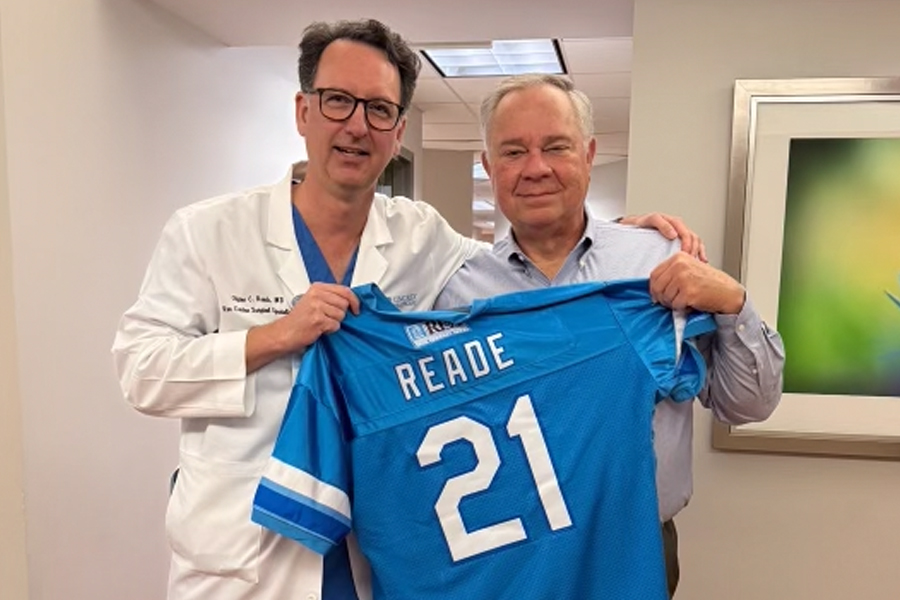
Still, Evans has an overwhelming appreciation for how lucky he is, and he had a jersey made for Dr. Reade with the number 21 on the back—the number of minutes of circulatory arrest, when he was on the bypass machine.
“Dr. Reade tells me it’s one of the worst tears that somebody survived,” Evans says. “I got a copy of the report of everything that happened to me, and if any person would have done anything different than what they did, I wouldn’t be talking today.”
That includes Evans himself.
“Patients with aortic dissections have a very poor prognosis, with mortality approaching 50 percent within 48 hours of symptom onset,” says Hazel Doronila, the physician assistant who worked on the case. “I’m glad Mr. Evans was in tune with his body’s warning signs and took action as quickly as he did. He may not be where he is now if he hadn’t sought help.”
Everyone involved says teamwork was critical.
“You need an orchestra to be able to conduct this sort of case smoothly and appropriately,” Dr. Radwan says. “Rex is a very special place in that everybody comes together and knows their role very well. I think Ricky was definitely in the right place at the right time.”
It’s a fulfillment of the promise that Dr. Adams made to Evans years ago, but one that was only possible because Evans knew he had an aortic aneurysm.
“Aortic aneurysms are more or less a silent killer, because some of these ruptures happen without having significant symptoms,” Dr. Adams says, noting that risk factors for aortic aneurysms include age, high blood pressure and family history. “As you get older, you should have a screening ultrasound, and if you do have an enlargement, it should be monitored on regular basis.”
With regular monitoring, you can take steps that will help your overall health, such as controlling blood pressure and cholesterol levels and quitting smoking. Your doctor can also determine if the size of the aneurysm requires surgery.
Evans is continuing to recover from the surgery and is still astounded by the odds he beat with the help of the people at UNC Health Rex.
“It is nothing less than a miracle,” he says. “God teed up the miracle, but Rex delivered it.”
If you’re concerned about your heart health, talk to your doctor. If you need a doctor, find one near you.