


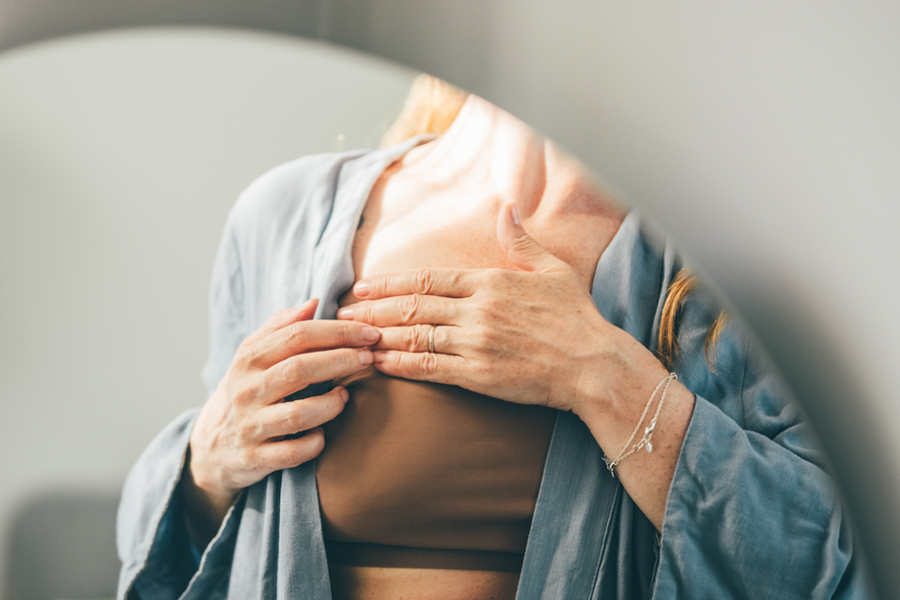
Cancer treatment tends to focus on removal and reduction: Cut out the tumor. Shrink the cancer cells.
But for some women with breast cancer, treatment also includes rebuilding. If you are a woman who undergoes breast removal surgery, a mastectomy, you may choose to get new breasts through a surgical process known as breast reconstruction.
“We know women who have gone through cancer usually have their self-image improved by undergoing breast reconstruction,” says UNC Health plastic surgeon Yemi Ogunleye, MD, “Dr. Yemi” to his patients. “It’s important women can make choices that allow them to have the best cancer treatment at the same time as a good reconstruction.”
Breast Reconstruction: Timeline and Methods
Plastic surgeons such as Dr. Ogunleye work closely with their patients’ oncologists. The goal is always to prioritize the main cancer treatment, whether that’s surgery, chemotherapy, radiation, immunotherapy, targeted therapy or a combination.
“It’s important to make sure whatever we do does not reduce the effectiveness or timeliness of your cancer care,” Dr. Ogunleye says.
The timeline differs with each patient; some get immediate reconstruction, in which the mastectomy is completed and the new breasts constructed all in one go. Your surgeon may use implants or expanders to stretch the skin for your new breasts in a surgery that follows months or even a year later. This is more likely if you have cancer that was caught early.
Or you might have delayed reconstruction, in which no reconstruction is performed initially and the new breast is constructed months or years later.
Between surgeries, you may receive treatment such as chemotherapy or radiation.
There are two broad approaches to creating new breasts. The first is flap reconstruction, which uses tissue such as skin, fat and blood vessels from the patient’s body. This “autologous” tissue may come from the belly, back, thighs or bottom, depending on technique. The second option is breast implants, filled with saline or silicone to mimic the appearance of a natural breast.
Dr. Yemi and two of his patients explain the pros and cons of each method.
Jamila’s Story: Working Mom Feels Like Herself Again
Jamila Simpson, 48, is a busy mom of two boys, a PhD and an

Simpson, who lives in Cary, NC, was in shock. She had just had a clear mammogram a month before but later felt a hardness on the top of her chest and had it checked out—and it’s a good thing she did. Her type of breast cancer doesn’t always show on a mammogram.
“I tell people, trust your instincts,” she says. “It was during COVID, and I debated going to the doctor, and I’m so glad I did.”
After considering her options for reconstruction, she chose the DIEP flap technique, in which skin, fat and blood vessels from her lower belly were used to build breasts. She didn’t want implants because they need to be replaced every 10 years or so.
Using your own tissue requires a longer operation, a longer hospital stay and recovery, and can be more painful because there are two surgical sites, Dr. Ogunleye says. But it’s often preferred by younger women, and unlike implants, your tissue changes with your body if you gain or lose weight.
Simpson had a double mastectomy in February of 2021. (Because the flap surgery can be done only once from the same site, she chose to have her right breast removed, too, in case it developed cancer someday.) Her surgeon put in expanders to stretch the skin, which she had filled with saline in regular visits.
About a month later, she had to have the expanders removed in emergency surgery because she had developed a staph infection. She dealt with pain, a long course of antibiotics and drainage tubes dangling from her body while she recovered. Because the cancer had spread to her lymph nodes, she had chemotherapy (she had to go alone because of COVID-19) and radiation, which left burns on her skin.
The whole time she was checking in with Dr. Ogunleye—“he was keeping an eye on me”—even though her reconstruction wasn’t yet scheduled. She had been through enough that she briefly considered skipping it altogether and staying flat, but, “I wasn’t ready to not feel like myself.”
Finally, she finished treatment, and Dr. Ogunleye performed the reconstruction surgery on November 22, 2021—Simpson’s birthday. This time, she could be supported by her husband, Clarence, and she bought new pajamas and fuzzy pink slippers to “bring joy where I could.”
The surgery took 12 hours, and recovery was tough. Simpson walked stooped over at first because of tight skin, and she had new drains to empty every couple of hours. She was covered in bandages on her chest and abdomen that had to be changed and reapplied often; she slept in compression garments for weeks. Months later she had revision surgery with Dr. Yemi to even out her breast size; one side was bigger than the other because the skin was tight from a radiation burn.
It was all worth it, Simpson says.
“I felt honored to wake up and see a chest,” Simpson says. “I know women before me didn’t have that option. It felt like a gift.”
Peggy’s Story: Navigating Health Challenges and Making Big Plans
Peggy Young, 72, is an active grandmother of seven who sells

She was diagnosed with invasive ductal carcinoma in her right breast in 2022, after her mammogram showed areas of concern that led to a breast biopsy. A few days later, she had an MRI to look for the cause of her persistent headaches, and they found an aneurysm in her brain.
It was a lot of heavy medical news to get at the same time. Fortunately, the aneurysm wasn’t life-threatening, and the cancer was treatable. Young felt hopeful.
“All things work together for good,” she says. “I had kind of mentally prepared for it, and I believe strongly in the power of prayer.”
Young had a history of atypical ductal hyperplasia and lobular carcinoma in situ, which are overgrowths of benign (noncancerous) cells that raise the risk of breast cancer. More than a decade earlier, she had taken chemotherapy drugs in pill form to keep those precancerous cells at bay.
Now, she had cancer and needed to make decisions about her breasts. Based on her history and her concerns that the cancer would recur, she opted for a double mastectomy, which she had in August 2022, after her neurosurgeon said it was safe.
Young and her husband felt at ease with Dr. Ogunleye, who would do her reconstruction.
“We talked about church and what kind of music I like; he has a very soothing manner,” Young says. “He was very clear, and there was a lot of trust that happened at that first meeting.”
Young initially wanted a flap surgery using her own tissue, but a long surgery was a concern because of issues she had in the past under anesthesia. She worried about cutting into her abdomen because she knows core strength is important for balance as you age.
So Young opted for saline implants, which she received in February of 2023 after an MRI confirmed her aneurysm remained stable.
Afterward, she was happy with her breasts’ size and general appearance, but Dr. Ogunleye had told her reconstruction is a process, and he was right. About a year later, she got liposuction to transfer fat from other parts of her body into the implant area, to soften the edges and make them look more natural. In late 2025, Dr. Ogunleye performed a revision surgery to tighten the implant “pockets” and keep her new breasts in place.
After three years of surgery, recovery and healing, Young is feeling strong and exercising on a rowing machine and stationary bike while working 20 hours a week. She maintains a private Facebook support group for people with breast cancer and survivors, and she and her husband just booked a 50th anniversary trip to the Canadian Rockies.
“I feel like I’m getting my mojo back,” she says.
That’s the whole point, whether you choose autologous tissue transfer or implants for breast reconstruction, Dr. Ogunleye says.
“Regardless of what you choose, we can get most women where they want to be,” he says. “We can make natural, beautiful breasts both ways.”
Do you have questions about breast health? Talk to your doctor or find one near you