


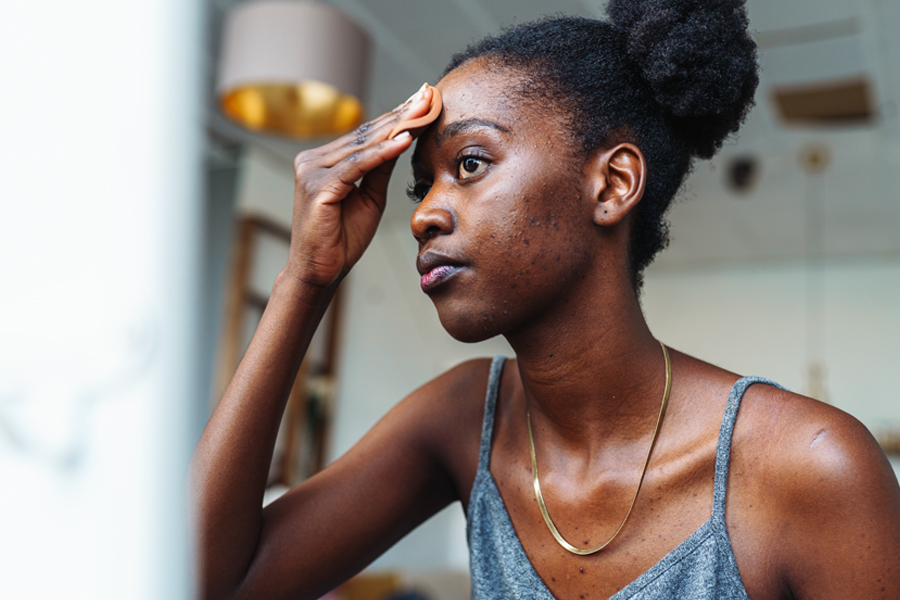
When you’re a teenager, acne is unwelcome but expected. As an adult, it can feel like a cruel joke—all these grownup responsibilities and I still get pimples?
Despite its association with teenagers going through puberty, adult acne is common, particularly among women. For some, teenage acne never really goes away. For others, their 20s or 30s may be the first time they deal with problem skin.
We spoke with UNC Health dermatologist Margaret Coates, MD, about what causes adult acne and some do’s and don’ts for treatment.
Causes of Adult Acne
For both teen and adult acne, genetics plays a factor; if your parents were prone to breakouts, you will be, too.
In teens, shifting hormones during puberty cause excess oil production that clogs pores and leads to breakouts, particularly on the forehead, nose, cheeks and chin. For men, these hormones tend to stabilize, but because women continue to have monthly hormonal shifts with menstruation, breakouts may continue.
Adult pimples tend to be more on the jawline, around the mouth and the chin. Rather than whiteheads or blackheads, you may notice deeper and redder pimples, indicating more inflammation, and they may be more painful than they used to be.
“Big hormonal changes are still happening for women in their 20s and 30s,” Dr. Coates says. “Women may notice flares that coincide with their menstrual cycle. You may also notice big flares during perimenopause.”
Some hormonal conditions, most notably polycystic ovary syndrome, can cause acne. So can pregnancy, stress and some medications, most notably the corticosteroids you might take for asthma, allergies and autoimmune conditions.
“There’s also mild evidence that diet plays a role,” Dr. Coates says. “Foods that raise the blood sugar quickly or high levels of dairy or dairy-derived protein may contribute to acne.”
Do’s and Don’ts for Treating Adult Acne
Do: Look for a cleanser with benzoyl peroxide.
Start your treatment with a face wash that has benzoyl peroxide, which kills the bacteria that causes acne, reduces inflammation and unclogs pores.
“Look for a cleanser that has 3 to 5 percent benzoyl peroxide,” Dr. Coates says. “You also can use a body wash with benzoyl peroxide if you have acne on your body.”
Many face washes geared toward acne have salicylic acid. If these products work for you, you can continue to use them, but they can be drying and not always effective against adult acne, Dr. Coates says.
“Salicylic acid helps to break down oil, and it has a role when there are a lot of open comedones, or blackheads,” she says. “Adult acne tends to be less about oil production and more about inflammation.”
Don’t: Follow every skin care trend or try every product.
If you’re prone to acne flares, be careful about taking advice from online influencers.
Dr. Coates gives this example: An online trend called “slugging” encourages putting on your nighttime skin care products, such as a moisturizer, and then covering your face in a heavy layer of Vaseline to seal in the moisture.
“That’s recommended for some people with dry skin, but if you have acne, putting products under an occlusive layer can be irritating,” Dr. Coates says. That’s especially true for a retinoid or retinol. While these products target acne, putting them under an occlusive layer will cause more irritation and breakouts.
Some influencers tout vitamin C to stimulate skin collagen and keep skin looking youthful, but it can cause breakouts.
Ask your dermatologist if there are any active ingredients you should avoid, and remember that not every product marketed for acne will be effective for adults.
“Of all the products marketed for acne, I recommend against exfoliants,” Dr. Coates says. “They remove a layer of skin, which doesn’t help acne. They’re irritating and cause redness, dryness and discomfort.”
Do: Take advantage of over-the-counter retinoids.
Retinoids are a range of products that use vitamin A to clear acne. The strongest formulation is only available by prescription, but there are several over-the-counter options, generally called retinols. With a prescription retinoid, your body can use the vitamin A more quickly; with over-the-counter options, your body has to convert the formula into vitamin A, so while it’s not quite as strong, it’s a good first step.
“Retinoids can cause dryness and irritation, so it can be helpful to start with a lower-strength, over-the-counter version so your skin can get used to it,” Dr. Coates says. “Start by using it two or three times a week, and then gradually increase the frequency. It’s really helpful if you can tolerate a lower-strength product every night before increasing to prescription strength.”
Adapalene gel is a retinoid that used to be available only by prescription that is now available in most stores.
Retinoids—prescription or over-the-counter—are not safe during pregnancy. For something that is safe during pregnancy and less irritating, Dr. Coates recommends products with azelaic acid, which is anti-inflammatory like benzoyl peroxide.
“It also helps with hyperpigmentation as a result of acne, which is a nice bonus,” Dr. Coates says.
Don’t: Buy an LED mask without doing research.
Before you spend money on an LED light-based device, do some research or talk to your dermatologist. These masks, which aim wavelengths of red or blue light at your face, claim to reduce acne and fine lines, but Dr. Coates says that most of them do nothing. And don’t be swayed if the product claims to be “cleared” by the Food and Drug Administration.
“For devices that are used at home, a company only has to go through FDA clearance, which is different from FDA approval for medications,” Dr. Coates says. “To get FDA clearance, you just have to show that the product isn’t harmful. You don’t have to show any evidence about efficacy, or how well they work.”
Some companies may present research findings about their products, but it’s important to consider that these are often small studies and not always scientifically sound.
Do: Talk to your dermatologist if you want more help.
If over-the-counter options aren’t helping and you’re bothered by acne, talk to a dermatologist.
“When you see a doctor, your options become much more plentiful,” Dr. Coates says.
There are several topical lotions, gels or wipes that your doctor might consider, including prescription-strength retinoids and azelaic acid. They may recommend topical antibiotics, which kill skin bacteria and reduce inflammation. Some prescription options combine multiple ingredients for maximum effect, such as a retinoid and an antibacterial.
Your doctor might consider oral medications, which are typically taken daily. Some are meant for short-term use, while others you take for longer. A low-dose antibiotic can be prescribed to reduce skin inflammation, while a drug called spironolactone is particularly helpful for adult hormonal acne, Dr. Coates says. Isotretinoin, or Accutane, is effective for severe acne but because of potential side effects, you’ll see your doctor more regularly for blood work.
If you’re considering an oral contraceptive, talk to your doctor about whether it could also benefit your acne.
With any treatment, ask your doctor about any lifestyle changes you should make. Both topical and oral medications may make your skin more sensitive to the sun and prone to dryness; your provider can recommend products that will ease those symptoms without worsening your acne.
An added benefit of seeing your dermatologist regularly: They will know about any new treatments that could help your particular case, such as lights or lasers.
Don’t: Expect quick results.
Whether you’re using an over-the-counter product or a prescription medication, it’s going to take some time for acne to resolve.
“That’s the hardest part,” Dr. Coates says. “It will take six to 12 weeks for these medications to really kick in. Some of the oral treatments can work a bit faster, but topicals take longer.”
If you’re dealing with a huge zit right before a big event, you can use adapalene gel as a spot treatment; it can help inflamed pimples go down more quickly. Don’t pop the pimple or otherwise touch it. To help with that, borrow a style tip from today’s teenagers. You may have seen young people wearing “pimple patches,” maybe in the shape of a star or a smiley face. These are hydrocolloid patches, which can be bought at a drugstore, and they help keep you from touching or picking at your blemish, which could slow healing.
“It’s been exciting to see these become so mainstream, with fun shapes and designs,” Dr. Coates says. “It’s become OK to go out with them, so that there’s less of a stigma about acne.”
Tired of breakouts? Talk to your doctor or find one near you.