

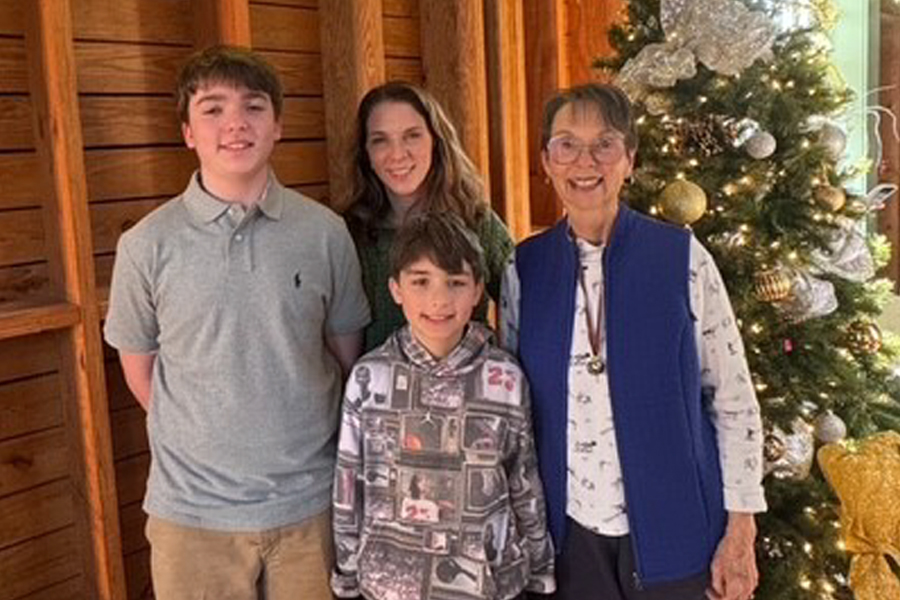
Ann Herndon learned she had multiple myeloma, a rare blood cancer, in 2013, just as she was beginning an exciting part of her life: being a grandmother.
She set a goal of seeing her little grandsons graduate from high school, but it didn’t always seem possible.
“In 2020, I had a stem cell transplant, and I would hear different stories about people living maybe four or five years after their transplant,” Herndon says.
While Herndon experienced four years of remission of her multiple myeloma after the stem cell transplant, the disease returned in 2024. But by that point, there were new options available, and Herndon, now 78, chose to participate in a clinical trial. Now, she is in remission again, and her grandsons, Lincoln and Grant, are 14 and 11.
Her dreams have moved past high school graduation.
“It feels like there’s a real possibility, Lord willing, that I will get to see these boys graduate from college and become men,” Herndon says. “The treatments have come such a long way since I heard those stories in 2020.”
Herndon’s optimism is shared by her UNC Health oncologist Sascha Tuchman, MD.
“People with multiple myeloma are living longer than ever before, so many people are living long enough to access new generations of medications,” he says. “A person diagnosed today will probably live long enough to benefit from multiple new treatments being developed in the lab now.”
Clinical Trials for Multiple Myeloma
Herndon’s 2024 relapse following her stem cell transplant and other treatments wasn’t unexpected.
“Relapse is part of the reality with multiple myeloma,” Dr. Tuchman says, noting that while early multiple myeloma often doesn’t cause symptoms, this currently incurable cancer can eventually affect the immune system, bones and kidneys. “One of the benefits of being treated at a place that specializes in multiple myeloma is that we have lots of things we can try to get a person back into remission, even if we still don’t have the definitive cure. There are lots of reasons to be hopeful.”
When Dr. Tuchman presented Herndon with the opportunity to participate in a clinical trial, she said it took her only minutes to decide.
“I wanted to do it for myself, but when I thought about the trial helping others with multiple myeloma, and what it could do in the long-term, I was in, all the way,” Herndon says. “It just feels so good to think about having a part in helping find medications for others.”
In March 2024, Herndon began receiving weekly injections of two medications at the UNC Hospitals Hillsborough Campus as part of the clinical study. She experienced some side effects, such as losing her sense of taste and struggling to eat as a result, but her clinical team helped her with them.
“We try to encourage people to live life and let us use our expertise to manage those side effects,” Dr. Tuchman says, noting that the new drugs being developed now typically have fewer side effects than previous medications for multiple myeloma.
“That’s why clinical studies are often a win-win,” he says. “The person participating gets a medication to control their myeloma that’s hopefully more effective than the usual treatments, with fewer side effects, but that may not be FDA-approved and routinely available yet. In addition, these studies help us to prove these approaches work and get FDA approval for these new medications that will improve care. It advances science, and we make sure it’s safe and effective for the patient.”
After about a year of treatments, Herndon’s multiple myeloma was in remission again; she now gets monthly injections of the medications.
Staying Active with Multiple Myeloma
Herndon believes that staying active in her community and with her family has been a crucial part of her journey with multiple myeloma. Her husband of 38 years, Tom, died in 2012, but she lives close to her daughter Kelli and her family as well as her sister.
“It really helps to try to get up and start moving, rather than to sit and mope,” she says. “You have to find people and not be afraid to ask for help. When I can, I try to ask somebody to go with me to the treatment, because just seeing a good friend during that time makes it so much better.”
Herndon sees her grandsons almost every day. She and 11-year-old Grant like to feed the horses at a farm near their homes outside Pinehurst after school. A big highlight of last year was helping prepare and serve pre-game meals for 14-year-old Lincoln’s football team along with other mothers and grandmothers.


“It was such a lift for me to go there every week and help,” Herndon says. “It’s a boost to be around younger people. When you get old, you don’t want to sit back!”
Herndon was honored by the coaches and team during a cancer awareness game and looks forward to volunteering again next season.
She is excited that the medications that are working for her may one day be available to others.
“When Dr. Tuchman told me that I’m in remission, he said that if anything happens in the future, there are so many other medications coming out in the future that will be able to help, and that just made my heart flutter with happiness,” Herndon says. “It’s so worthwhile to be in a clinical trial. I hope to be here for a very long time.”
If you’re interested in participating in a clinical trial, talk to your doctor. If you need a doctor, find one near you.