


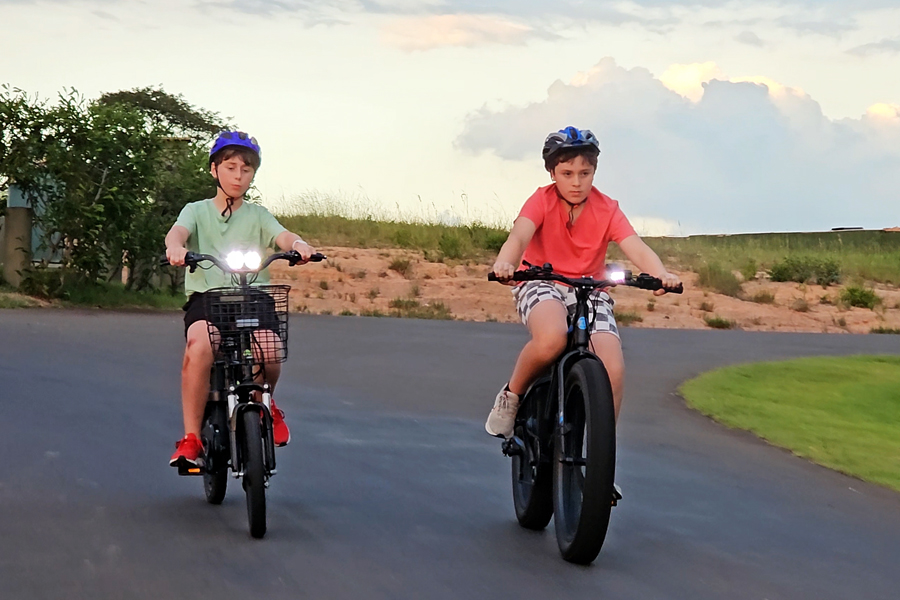
Recently, Daniel Park, MD, fielded a question from his oldest child, age 12.
Can I have an e-bike?
“I said no, and I will continue to say no,” says Dr. Park, who is a UNC Health pediatric emergency medicine doctor. “I see too many injuries of kids on e-bikes.”
E-bikes are a fun way to get around, but their higher speeds and heavier frames make them more dangerous than traditional bicycles. As more young riders take to the roads, doctors like Dr. Park are seeing a troubling rise in serious injuries.
Between 2017 and 2024, electric bicycles were involved in more than 155,000 emergency department visits and 310 deaths. E-bike fatalities rose from zero in 2017 to 97 in 2024.
Of course, e-bikes remain popular despite these risks. Here’s what Dr. Park wants parents to know for safer use.
-
Kids younger than 12 should not ride an e-bike.
Before age 12, kids should not ride any e-bike, Dr. Park says, following guidance from the American Academy of Pediatrics. They do not have the skill or brain development to safely operate something that can go faster than 10 mph.
-
Kids ages 12 to 15 should use only a class 1 bike.
All e-bikes are not the same. They’re divided into three classes: class 1, which can reach speeds of up to 20 mph but only when the rider is pedaling; class 2, which also reaches 20 mph but includes a throttle, so pedaling is not required; and class 3, which can reach speeds of 28 mph or more.
If you’re choosing an e-bike for your 12-year-old or young teenager, choose a class 1. For age 16 and up, you can consider a class 1 or 2, according to the American Academy of Pediatrics. But age shouldn’t be your only guide, Dr. Park says.
-
Assess your child’s maturity and skill before allowing them to ride an e-bike.
Just because your child is 16 and has been riding a bike for a decade doesn’t mean they can safely operate an e-bike, Dr. Park says. E-bikes require skill and thoughtfulness that not all kids develop at the same time.
For example, you must start braking earlier because of an e-bike’s weight and speed. You have to follow posted traffic and pedestrian laws and be comfortable speaking to strangers to keep everyone safe (such as calling out “passing on your left” to a walker).
Riders of traditional bikes should do these things too, but e-bikes leave less room for error, Dr. Park says.
“Obviously it’s higher speed, higher energy, higher impact if you hit something,” he says.
-
Protect your child’s head.
Head injuries are a common reason e-bike riders end up in the hospital. Dr. Park sees concussions, skull fractures and bleeding in the brain, which can cause death.
A properly fitting helmet is essential, Dr. Park says. E-bikes and other motorized vehicles require a helmet with a higher level of protection, according to the Consumer Product Safety Commission, which sets standards based on activity. For e-bikes they recommend helmets with face protection, like a motorcycle helmet.
Make sure your child knows that without a helmet, there can be no ride.
“You double your odds of a head injury if you’re on an e-bike without a helmet,” Dr. Park says.
-
Know that it’s tough to find a safe place to ride an e-bike.
E-bike riders on public streets are at risk because of cars, which can cause catastrophic injury in a collision. But on sidewalks and bike paths, e-bikes endanger pedestrians, including young children and pets who don’t know to get out of the way.
“There’s almost no safe space for these things,” Dr. Park says. “And they’re still new enough that people aren’t used to riding them, and drivers aren’t used to sharing the road with them.”
When a car hits an e-bike, the rider is likely to sustain what doctors call polytrauma, affecting multiple body parts and organs. This could mean a head injury, multiple broken bones and internal bleeding, Dr. Park says.
Anyone, adult or teenager, who rides an e-bike, especially on a street, needs to ride predictably, follow traffic laws, make sure they are visible with light and reflective clothing, and eliminate distractions such as music and phones, Dr. Park says.
“The issue is with children who don’t know how to do any of those things because they’re not ready for them,” he says. “And even with all that protection, you can’t control what happens on the road.”
If you have questions about your child’s safety, talk to your doctor or find one near you.