


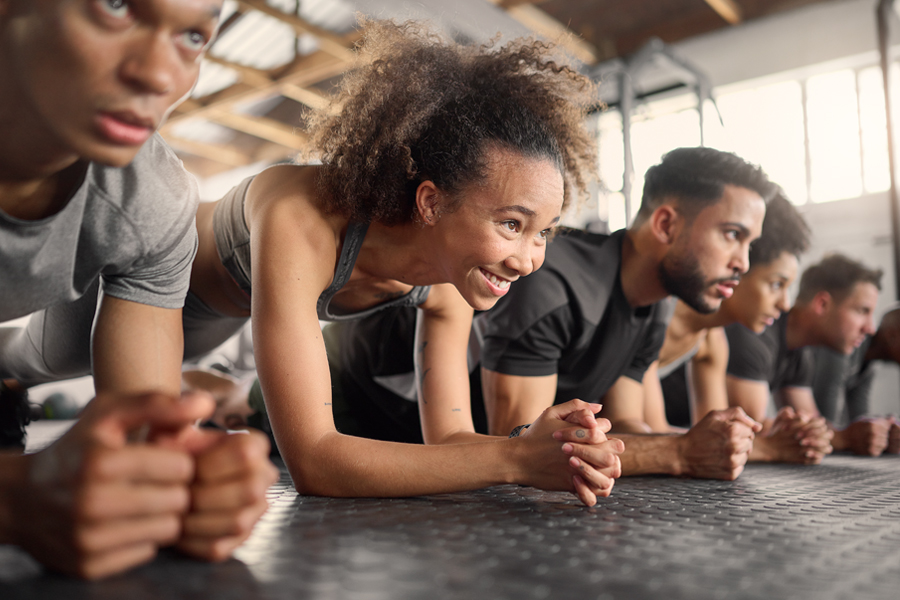
If you’ve ever taken an exercise class or worked with a personal trainer, you might have been instructed to “engage your core.”
“A lot of people just tighten up their stomach when they hear that, or they think the core is only about an abdominal ‘six-pack,’” says UNC Health sports medicine physician Anthony Garzone, DO. “The core is actually a 360-degree midsection system that includes your abdominal muscles, lower back muscles, diaphragm and pelvic floor.”
To use the entire core, stand or sit up straight with good posture. Take a deep breath, and as you exhale, pull your belly button to your spine and hold it there while also pulling up from the pelvic floor (imagine holding the muscles that would allow you to stop urine midstream). Think about keeping all those muscles active, but don’t hold your breath as you do so.
If this feels difficult, you’ve probably been neglecting your core. Here’s why you need to add core strengthening to your workout routine and how to do it.
The Importance of the Core
When you think about how you move, you probably think about your limbs—walking with your legs or using your arms to push yourself up from a reclined position. But your core is crucial as well.
“Every movement, from walking to sitting or standing, uses the core,” Dr. Garzone says. “The core is the link between the upper and lower body and helps to stabilize you.”
The core protects your spine and is key for preventing chronic back pain.
“The spine is inherently unstable, so it relies on the core muscles to act like dynamic guidewires, keeping it aligned during movement,” Dr. Garzone says. “When a weak core doesn’t stabilize the spine, the spine shifts pressure onto more passive structures like the ligaments and discs in your lower back, stressing the lower back and causing pain.”
If you’ve ever been able to stop yourself from falling when you trip over something, you likely have your core to thank—it helps maintain your balance and coordination.
“The core is really tied to independence as we age,” Dr. Garzone says. “A strong core can mean fewer falls and the ability to do the activities you love for longer.”
For athletes, a strong core helps prevent injury and provides more power in performance.
“About half the energy for throwing comes from the core, so when the core isn’t strong, there can be stress on the shoulder and elbow,” Dr. Garzone says. “For golfers, a strong core means you can hit the ball further with less strain. A runner with a strong core will have less wasted energy and fatigue late in the race, because they can maintain good posture.”
Strengthening the Core
Strengthening your core makes it easier to move without pain, improve your posture, prevent falls and enhance athletic performance. But even the most dedicated exercisers can neglect the entire core.
“People tend to overfocus on the abdominals with sit-ups and crunches and neglect the back, pelvic floor and their breathing,” Dr. Garzone says. “A weak diaphragm leads to weak intra-abdominal pressure, which puts more stress on the spine.”
That means you can begin to strengthen your core just by breathing deeply, from your belly. But don’t stop there. Next, focus on stability and control.
“Start with simple moves like plank, side plank, dead bug, bird dog and bridge,” Dr. Garzone says. “Focusing on proper technique leads to real-world strength.”
If you’re not sure about your technique, it’s helpful to work with a personal trainer who can show you good form; there are also online resources.
Many effective core exercises rely on anti-movement, or keeping the core centered and controlled when another part of the body is moving. For example, with an exercise such as a one-handed overarm carry, you hold a weight above your head with one hand. To continue to stand up straight and not lean to one side, your core has to resist movement to counteract the force of that weight. To perform an ab roll-out, where you move from a kneeling position in and out of a plank on a wheel or a ball, you must activate all the core muscles to maintain good form.
Dr. Garzone also recommends moves that engage the core and build functional strength, such as squats with a medicine ball or an overhead press. As your core gets stronger, gradually increase resistance while maintaining control and proper form.
Engaging those deep stabilizers during your workout through anti-movement and functional movements will help you maintain control and balance in real-world situations such as carrying bags of groceries or putting a suitcase in an overhead bin.
Because of the core’s importance to full-body movement, it’s best to incorporate core work into every workout you do.
“Doing small chunks of consistent work regularly is better than doing a ton of core work once or twice a week,” Dr. Garzone says. “Just 5 to 10 minutes a day of core exercises can transform how you feel.
Have questions about exercise? Talk to your doctor or find one near you.