


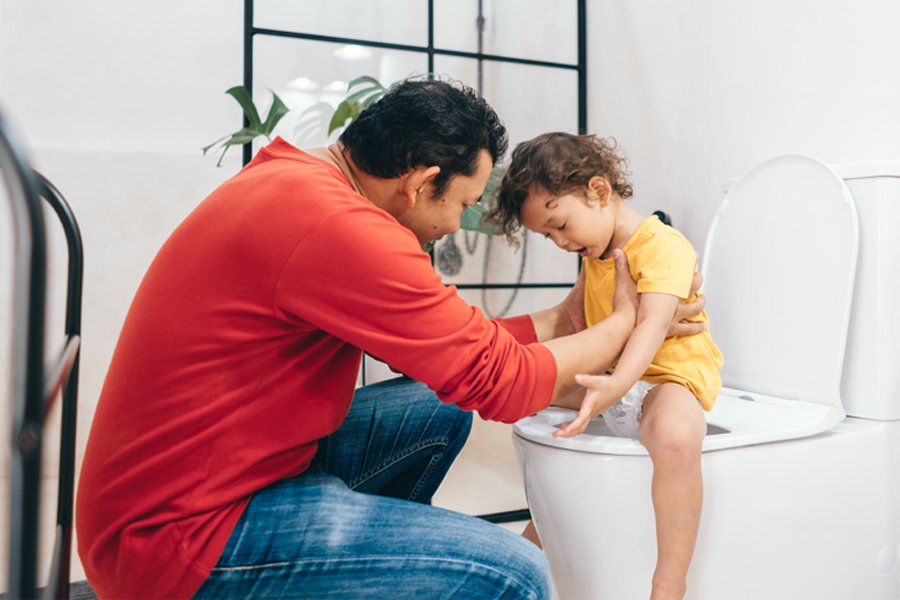
A child needs about 8,000 diaper changes in their first years of life. And if you’re the parent of a toddler, you’re probably wondering how many more you’ll have to do before your child can go to the potty on their own.
“Every child is different, but most children develop the physical, cognitive and emotional readiness for toilet training between 18 and 30 months,” says UNC Health pediatrician Tarshree Sawyer-Knox, MD, MPH. “Allow your kid to go at their own pace, and don’t compare them to other kids.”
While the idea of leaving diapers behind sounds like a relief, it will be a process to teach your child to respond to their body’s cues and get to the toilet. Dr. Sawyer-Knox shares some tips for beginning this process.
1. Let your child lead the way.
Instead of deciding that you need to start your child’s potty training at a certain age, look for signs that they’re ready to begin. They may even tell you that they want to use the toilet.
“You may see them becoming independent in other ways and wanting to do things for themselves,” Dr. Sawyer-Knox says. “They start to take pride in their abilities, and you notice they respond to praise and want to please you.”
Your child should have enough communication skills to talk about the process. You can start to point out to them when they’re about to go to the bathroom.
“If they can follow simple instructions and are starting to understand those words about going to the bathroom, that’s a big sign,” Dr. Sawyer-Knox says.
It’s also helpful if you feel your child has a predictable bathroom schedule and is staying dry between changes for longer periods—that will help you plan when you can help them sit on the potty to try.
2. Find the right time and prepare.
As adults, we can take for granted how easy it is to go to the bathroom. But it’s all new to a child who is used to wearing a diaper, and it will take time to learn.
“Every child is different in terms of how long it takes, so you need to be sure you have a period of time when you can focus on this and be consistent for a few months,” Dr. Sawyer-Knox says.
It may not take a few months, but you’ll still want to be sure you have ample time to let your child focus on these new skills without interruption. If you try to squeeze this process into a few weeks right before a vacation, a move or a new school, you may not be able to provide the consistency needed, and your child may feel the pressure.
You’ll also need equipment—you could get a little potty chair that sits on the floor, or a seat that goes over a regular-sized toilet, with a stool that helps your child get up there. Both work, Dr. Sawyer-Knox says; it’s just a matter of which your child prefers.
“Sometimes it’s easier to start with a potty on the floor because access to the potty is better, but some children like to use a real toilet and flush,” she says.
Books that explain going to the potty are also helpful for children, and consider their clothing as well—be sure they have some pants with elastic waistbands that are easy to get on and off. Some children enjoy picking out their own big-kid underpants.
3. Once you start potty training, stay consistent.
You can start the process of toilet training by having your child sit fully clothed on a potty so they get used to the feeling. Then, start having them sit on the toilet without a diaper a few times per day. Consistency is key, so aim for the same times every day.
“When they wake up, before bed and after meals are great times to practice sitting, for no more than five minutes at a time,” Dr. Sawyer-Knox says. “Then start to increase the number of times they sit.”
The first few times they sit on the potty, don’t expect them to actually go, but if you pick times you know they have to go, they might.
If your child has had a few successes and is communicating the desire to go, you may feel ready to transition from diapers to underwear; stay consistent with that choice as well.
“Don’t go back and forth once you start with underwear,” Dr. Sawyer-Knox says. “Stay with one thing for the entire day. There will be accidents, but your child needs to feel if they’ve wet themselves.”
If your child goes to day care or has another caregiver, make sure everyone is on the same page with the plan.
“If the day care is using a sticker chart, you can use one at home, too. It can make the process go more quickly when there’s consistency,” Dr. Sawyer-Knox says.
4. Make using the potty a happy occasion.
Celebrate every small win in this process—from your child merely sitting on the potty to your child actually peeing or pooping in it.
“Praise is so important to this process, so make a big deal of it,” Dr. Sawyer-Knox says. “In my house, we have a dance party. Children are happy to see their parents having fun with them and being proud. It makes them want to do it again.”
A sticker chart—where peeing or pooping gets the child a sticker that can be redeemed later for a treat—is helpful reinforcement, but don’t take stickers away if your child doesn’t make it to the potty.
“If a child has a negative experience or feels pressured, they may not want to go anymore, and we want potty time to be a happy time,” Dr. Sawyer-Knox says. “Some children may try to control the situation by withholding their stool, and then they get constipated and have a painful experience, which makes them even more fearful of the potty.”
If you feel this becoming a battle, stop the process completely and give your child time to forget the negative experience. Then, restart at a time when your child feels ready again.
One way to keep potty time fun is to put a few of your child’s favorite books near the toilet so they can look at them as they sit.
5. Remember that accidents will happen, especially at night.
If you have a kid that has an easy, quick time of toilet training, that’s wonderful. But if you don’t, know that’s completely normal. Most kids will have accidents and regressions.
“When accidents happen, don’t show disappointment or frustration,” Dr. Sawyer-Knox says. “That can make a child not want to go to the potty at all anymore.”
Focus on using the potty during the day at first.
“Nighttime continence is a whole different ball game and usually comes much later,” Dr. Sawyer-Knox says. “Some kids will continue to wet the bed at night for a few years. Bed-wetting gradually decreases over time, with most children achieving nighttime dryness by adolescence.”
You can help your child avoid nighttime accidents by decreasing fluids after dinner and ensuring they go to the bathroom before bed.
If your family has a big change—a move, a divorce, a death of relative—you might see regressions in a toilet-trained child. This is normal and will resolve. Try to stay positive in front of your child, and give yourself grace.
“Kids do this on their own time, but it will happen,” Dr. Sawyer-Knox says. “Your pediatrician can always help.”
If you have questions about potty training, talk to your child’s doctor. If you need a doctor, find one near you.