
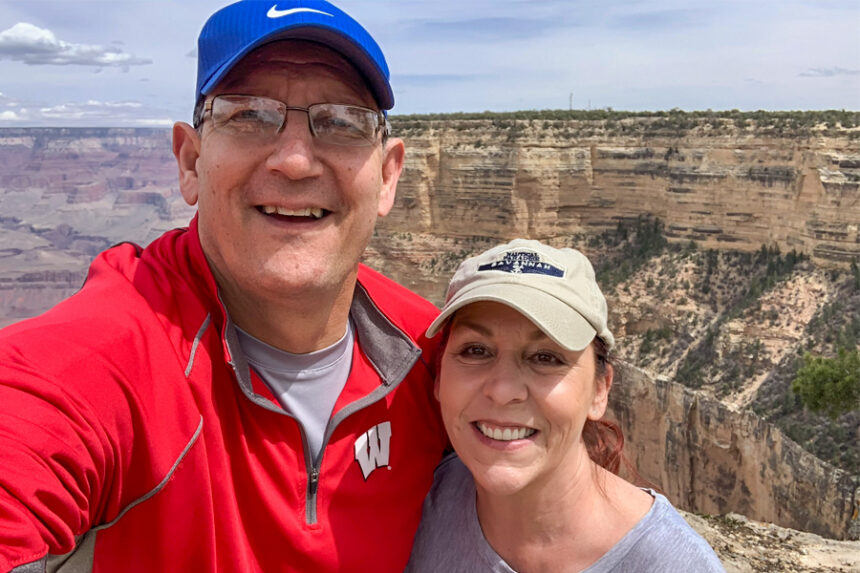

For the past few years, Larry Stefanski, 67, has been struggling with pain in his left hip and working with doctors to try to find relief. In 2024, his orthopedic doctor ordered an MRI to look for the cause. It didn’t show any issues with the left hip, but they did find a tumor on the sciatic nerve on his right hip.
“When you hear ‘tumor,’ you think the worst and worry you have cancer,” Stefanski says. “I had no symptoms on my right side, so if I hadn’t had that MRI, we wouldn’t have found it. But it was growing fast—I’d had another MRI a year earlier, and it wasn’t there then.”
Stefanski was referred to two different orthopedic surgeons, but both told Stefanski they didn’t operate on this type of tumor.
“When you see a new doctor, you’re scared to begin with,” Stefanski says. “To get in with a new doctor and be told they can’t help was really unnerving and frustrating for me and my wife.”
Finally, Stefanski’s primary care provider referred him to UNC Health neurosurgeon Mark Attiah, MD, who specializes in nerve tumors.
“My wife and I are believers in God and believe that everything happens for a reason,” Stefanski says. “We had all this frustration about seeing those two doctors who couldn’t help, but we eventually ended up with the perfect doctor and staff. Everything about the experience with Dr. Attiah was perfect.”
Sciatic Nerve Tumor and Sciatica
You’ve probably heard of sciatica, or pain along the sciatic nerve, which runs from the lower back and down the back of each leg to the feet. Sciatica patients are often referred to orthopedic doctors for treatment of their lower back pain. That’s often appropriate; these doctors can consider whether bones are compressing or pinching the nerve, but they don’t tend to deal with the nerves themselves, Dr. Attiah says.
That means patients often see multiple doctors with no results like Stefanski did.
Stefanski’s tumor wasn’t causing symptoms yet, but it eventually would have manifested as sciatica: pain, numbness and tingling in the lower back, buttocks and legs.
“These tumors are rarer than pinched nerves, so they’re commonly misdiagnosed,” Dr. Attiah says. “Doctors hear symptoms like pain, tingling or burning and think it’s a herniated disc or a bone spur, and then once they see something is on the nerve, they don’t want to touch it. That’s understandable, because if surgery on the nerve is not done correctly, it can cause weakness or paralysis.”
Dr. Attiah had pursued additional training to operate on nerves, so he was familiar with this type of tumor and could remove it for Stefanski.
“At the first office visit, he reassured me that almost all of these types of tumors are benign, but that he’d be able to remove it to make sure,” Stefanski says. “He understood that this was overwhelming but gave us a lot of calm and reassurance that we weren’t dealing with the worst-case scenario.”
Surgery for a Sciatic Nerve Tumor
If you hear someone had surgery with a neurosurgeon, you’d probably think they had a brain operation. But for Stefanski’s surgery in May 2025, Dr. Attiah went through the muscle of the gluteus maximus—the buttocks—to access the sciatic nerve.
“He expected a five- or six-hour surgery, and that’s what it was, because you can’t just cut, yank the tumor out and sew it back up,” Stefanski says. “He explained that he’d have to be very meticulous with the nerve so that he didn’t damage it and cut off that pathway to the rest of my leg.”
Stefanski says he had some pain at his incision site but that his recovery was generally easy. He spent one night in the hospital and did not require prescription pain medication at home. A biopsy and pathology results confirmed that the tumor was not cancerous and another MRI revealed that the entire tumor had been removed; Dr. Attiah says it’s unlikely to recur.
While Stefanski is still dealing with some pain in his left hip, which is unrelated to the nerve tumor, he’s grateful he was able to avoid the future pain that was destined for his right hip. After spending 40 years as a police officer in Minneapolis and Chicago, he’s now retired and fills his days volunteering at his church and his granddaughter’s school (he and wife Krisi have six children and seven grandchildren). He also joined the Gideons International to share his faith, which he says was crucial to surviving this period when he had an unknown tumor and didn’t know if he would find a doctor who could help.
“You can get so angry and depressed in the moment,” Stefanski says. “Staying focused on God helped me step back from those negative emotions and realize that a failed appointment was part of this journey. I pray that if this happens to other people, they can step back from that frustration and keep going.”
If you’re dealing with chronic pain, talk to your doctor or find one near you.