
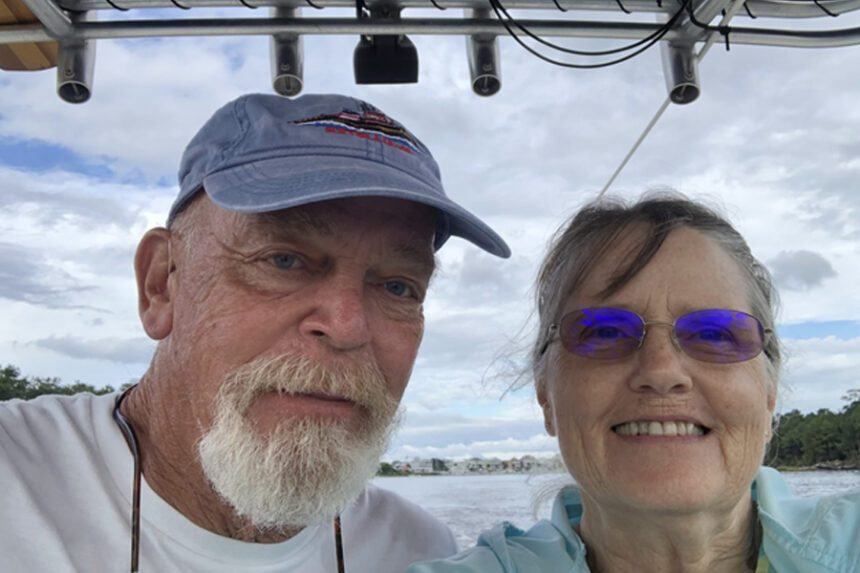
John Mote and his doctors have had their eyes on his lungs for a long time.
In 2013, a CT scan showed a nodule on the lower lobe of his left lung. Nodules are small growths that are usually noncancerous, but Mote had recently quit smoking after a stroke, so lung cancer was a concern. He began annual chest scans to monitor the nodule.
In spring 2025, a scan showed that the spot had grown larger. After a biopsy, he was diagnosed with stage 2B non-small-cell lung cancer..
It was concerning news, but the cancer was identified at an early stage and the prognosis was good. Mote, now 72, was hopeful that everything would turn out OK.
“It made me comfortable, hearing the same thing from the experts,” he says.
That optimism was well-founded: After five months of treatment, Mote’s chest scans do not show any sign of cancer, and he is ready to enjoy retirement with his wife, Ellen.
“It’s been very impressive, the care we’ve gotten,” Ellen says. “We’re so thankful.”
Treating Cancer As a Team
Mote lives in Wilmington, North Carolina, and was diagnosed there. His local health system reached out to the UNCH Health’s N.C. Basnight Cancer Hospital in Chapel Hill, where he met Carrie Lee, MD, MPH, a UNC Health thoracic oncologist who specializes in the treatment of lung cancer.
They connected right away because Dr. Lee went to medical school at Northeast Ohio Medical University in Rootstown, Ohio, where the Motes used to live. Ellen is a breast cancer survivor who participated in clinical trials through the UNC Lineberger Comprehensive Cancer Center.
Dr. Lee developed a plan of chemotherapy and immunotherapy treatment to shrink the tumor, to be followed by surgery. She says that in a quarter of similar lung cancer cases, chemotherapy and immunotherapy are so effective that there’s no lung tumor left to operate on.
Unfortunately, that wasn’t the case for Mote. After three chemotherapy treatments in May and June, Dr. Lee convened with Ben Haithcock, MD, a UNC Health thoracic surgeon, and they decided to pivot to surgery before the fourth treatment. The chemotherapy was making Mote very tired, and the tumor didn’t seem to be shrinking.
“We didn’t want to waste any more time if this wasn’t working,” Dr. Lee says, “especially if it was going to make him weak leading up to surgery.”
The lower lobe of Mote’s left lung was removed via robotic surgery guided by CT imaging in August 2025, along with lymph nodes in his chest where cancer cells can spread. After a successful surgery, Mote completed the fourth round of chemotherapy in September, and he is on track for a cure. To increase the chances of keeping it that way, he began a year of postoperative immunotherapy treatments in November; every three weeks, he gets an intravenous infusion of a medication.
“We were so delighted to see that he was getting better,” Dr. Lee says.
The Motes traveled to Chapel Hill for chemotherapy and surgery. His immunotherapy treatments can now take place closer to home in Wilmington. Throughout treatment, Dr. Lee has stayed in touch with Mote’s oncologist in Wilmington. The couple came away impressed with how well the providers worked together.
“This was a nice case of using the academic specialized center to set a treatment plan, in partnership with the local community provider,” Dr. Lee says.
Another Health Issue Faced and Resolved
Mote was admitted to the hospital in Wilmington in October with complications from the final chemotherapy treatment. While admitted, doctors diagnosed him with Addison’s disease, or primary adrenal insufficiency. This rare disorder occurs when the adrenal glands, which help regulate the body’s metabolism and blood pressure, don’t produce enough of the hormones cortisol and aldosterone. Mote had been suffering from gastrointestinal problems, one of the symptoms of Addison’s, for years without finding a cause. Since the diagnosis, he’s met with an endocrinologist and is on hormone therapy to treat the disease.
“I feel better than I’ve felt in 10 years,” he says.
The timing is perfect. Mote retired in 2023 from his work as a project manager for an environmental services company in Wilmington. In November, Ellen, a radiologic technologist, joined her husband in retirement.
The couple has plans for travel, including to Ireland, and John will have more time to take his boat out fishing along the North Carolina coast. It’s a reward at the end of a difficult 2025, and Mote gives credit to Ellen for her advocacy and support and to his doctors for their care.
“There’s no way I could have done it by myself,” he says. “It’s been a long process, but it’s been a good one.”
If you have questions about your risk for cancer, talk to your doctor or find one near you.