
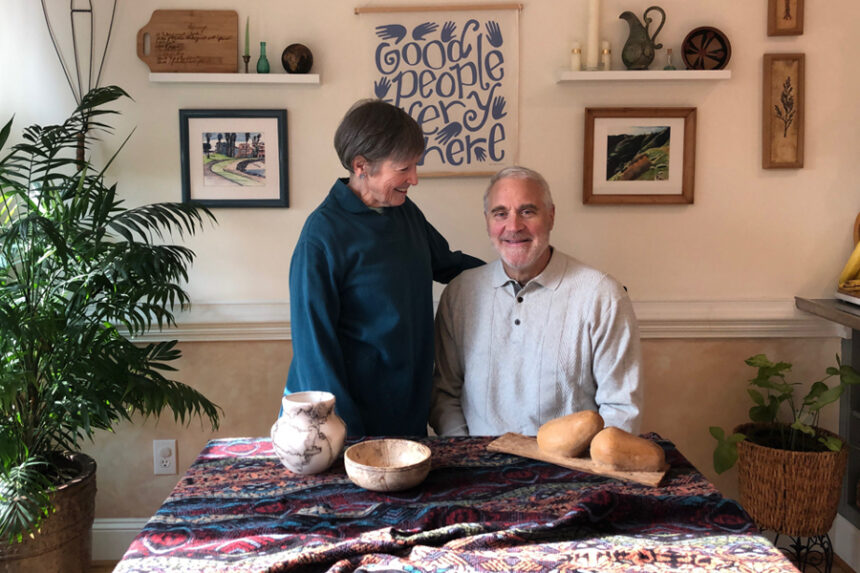
Jerome Stracke has met a lot of doctors and seen a lot of clinics and hospitals. For more than 40 years, he worked in healthcare, starting as a hospital supply clerk and working his way up to become a healthcare administrator before starting his own healthcare consulting practice with his wife, Janet.
So he knows what he’s talking about when he says that the care that he’s received at UNC Health for multiple myeloma is top-notch.
“From check-in to blood draws to treatment to checkout to communications, everyone is so professional and kind,” Stracke says. “When we arrive for each treatment, we know these great people care deeply about providing the best possible care, and that has given us great confidence.”
Multiple myeloma, a type of blood cancer, is relatively rare; the average lifetime risk of getting the disease is less than 1 percent, according to the American Cancer Society. That’s partly why Stracke, 67, feels so fortunate that expertise in this disease was available so close to his home in Cary.
“Because multiple myeloma is uncommon, many physicians may not have seen as much multiple myeloma as they’ve seen breast or lung cancer,” says UNC Health oncologist Sascha Tuchman, MD, who heads UNC’s Multiple Myeloma and Amyloidosis Program and treats Stracke. “If you’re newly diagnosed, go to a group where they specialize in multiple myeloma, so they have access to the latest and greatest treatments.”
Stracke and Dr. Tuchman share more advice for the newly diagnosed.
“You’re Not Sick; You Just Have Myeloma”
The Strackes live a healthy lifestyle. They eat well, exercise and see their doctors regularly. In August 2024, following his annual physical and blood work, Stracke’s primary care provider identified an abnormal protein in his blood called an M spike, which can indicate multiple myeloma. Testing showed Stracke had what’s called smoldering multiple myeloma, the precancerous stage. Just a few months later, in early 2025, the disease advanced to multiple myeloma.

Like many other patients with this diagnosis and in an early stage, Stracke experienced no symptoms. Eventually, the disease can cause weakened bones, kidney problems, anemia and an inability to fight infection when cancer cells outnumber healthy blood cells.
“Dr. Tuchman told me, ‘You’re not sick; you just have myeloma,’ and that really resonated with me,” Stracke says. “It made a big difference in how I approach this cancer. The only drama I’ve ever liked is in the theater, so I’ve focused on taking care of myself and educating myself about multiple myeloma.”
There is currently no cure for multiple myeloma, but more treatments have become available over the last few decades.
“People should know that the prognosis for multiple myeloma is better than ever before,” Dr. Tuchman says. “People are living longer and better than ever before. We still have work to do, but there has been a lot of progress.”
Unlike other cancers, multiple myeloma is primarily treated with medications, rather than surgery or radiation, and “the medications are better than they used to be,” Dr. Tuchman says. “We now have meds that are more targeted, more effective and have fewer side effects.”
Stracke started receiving weekly shots of a monoclonal antibody, a proteasome inhibitor, an immunomodulatory drug and a steroid, all of which work together to kill myeloma cells and activate the immune system to destroy them as they develop. He had his stem cells collected and frozen in anticipation of a future relapse and need for possible stem cell transplantation. Stem cell transplantation after chemotherapy is a common way of treating multiple myeloma, sometimes done as part of initial therapy and sometimes reserved for cases of relapse.
“I’ve responded so well to the treatments that now I’m only going in once a month; we’re starting to roll back the medications a bit, because I’m only on one right now,” Stracke says. “I’ve been very fortunate, because I’ve had no side effects. If I wasn’t diagnosed with multiple myeloma, I wouldn’t even know I had it.”
Advice for Families Facing Multiple Myeloma
While Stracke’s multiple myeloma doesn’t cause symptoms that affect his daily life, he says it does help him to appreciate life even more. He and Janet relish spending time with their three grown children and five grandchildren as well as traveling and volunteering together. He enjoys cooking, painting and sculpting.

The Strackes say that education about multiple myeloma was a crucial first step on this journey.
“My advice is to accept the diagnosis and understand as much as you can about it,” Stracke says. “Don’t be afraid to ask questions, and bring someone with you if you can. I had Janet with me the whole time, and I could focus on listening while she wrote everything down.”
Janet knows that they both had an advantage in their ability to educate themselves on the disease, given their years of experience in healthcare, but she encourages caregivers to get comfortable asking questions, too.
“I’d encourage people on this path to keep a notebook or journal to track of what happened on certain days, who you met, your questions,” she says. “It’s amazing how fast it can go, so it helps to have that record to center yourself on what happened when.”
While relapse is always a possibility with multiple myeloma, Stracke says he tries to focus on what he can control, which means maintaining his healthy habits of exercising, getting enough sleep, meditating to stay positive and telling “dad jokes” during his monthly treatments.
“These are things you can do, not just to survive, but to thrive with multiple myeloma,” he says. “I think taking care of myself has helped a lot. I meditate a lot in the evenings, or when I’m out on a walk, and it helps to tell myself that I can be healthy and positive with this.”
In fact, Stracke believes he is actually healthier now, as he gave up his nightly glasses of wine once he was diagnosed.
“The multiple myeloma diagnosis might have extended my life, because I don’t feel groggy anymore from drinking wine,” he says. “My life might have been different if I’d kept drinking alcohol. Now I’m so energized and feel so good.”
Stracke says there’s one instance when he can imagine a celebratory drink.
“I told Dr. Tuchman that when he finds the cure for multiple myeloma, I’ll buy a nice bottle of champagne and we’ll both drink it,” Stracke says. “He said that was a deal.”
If you’re concerned about your risk for cancer, talk to your doctor or find one near you.