


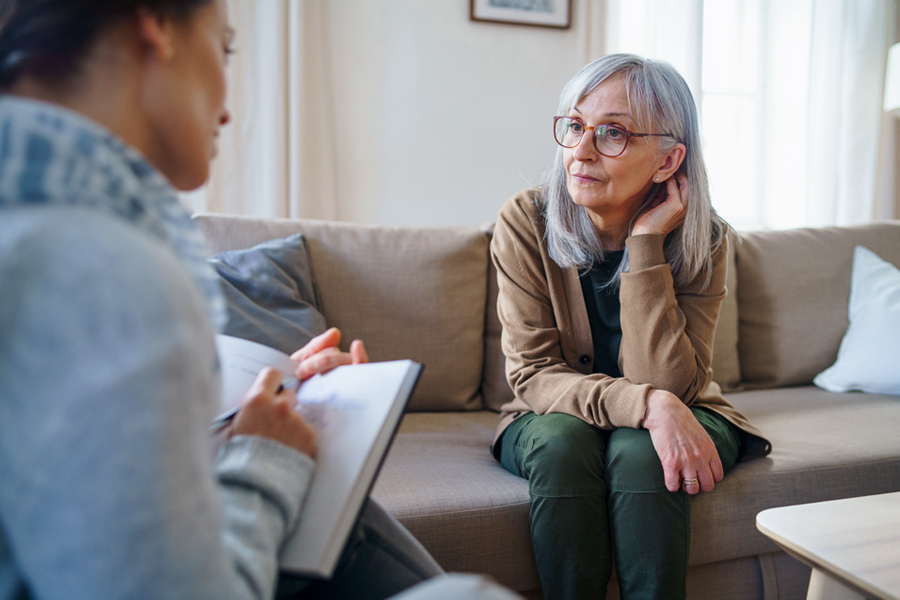
In recent years, more people have become comfortable talking about their mental health. But for some, there is still a perception that experiencing depression or anxiety is a sign of weakness. Adults older than 65 might be especially vulnerable.
“Stigma around mental health can be a huge issue for some older adults, who were taught that they should be stoic, independent and have it all together,” says Tamara Baker, PhD, professor of psychiatry at the UNC School of Medicine.
It’s not the only stigma that these adults face.
“We live in a society that doesn’t always value older adults and doesn’t always talk about what it means to age well,” Dr. Baker says. “How do you expect an older person to feel when there’s so much content about anti-aging? That has implications on mental health, in addition to not feeling comfortable talking to someone about it.”
This double stigma can make it hard to determine if someone is going through typical challenges of aging or needs mental health help. Dr. Baker explains the symptoms to know and steps to take if you’re concerned for a loved one.
Symptoms of Mental Health Conditions in Older Adults
The symptoms for depression, anxiety and other mental health conditions are the same no matter a person’s age. Too often, though, when an older person has those symptoms, we may assume it’s a function of aging or early signs of dementia.
“When a young person tells their doctor they don’t feel like themselves, that their body hurts, that they’re having trouble sleeping or concentrating, it’s more likely that it will be recognized as depression,” Dr. Baker says. “When an older adult says the same thing, people think, ‘Yeah, that’s because you’re old.’ That’s part of the stigma that so many have around aging.”
It’s also common for younger people to project depression or anxiety onto an older person, particularly if their spouse has died, they’re dealing with a chronic health condition or they’re not getting out as much as they used to.
“Becoming older brings many transitions that can be difficult, but we should not assume that just because a person is dealing with those that they’re depressed or anxious,” Dr. Baker says.
Symptoms to look for include:
- Difficulty concentrating, focusing or completing routine tasks
- Indecisiveness, particularly if it’s new
- Low energy and fatigue
- Irritability
- Changes in eating habits
- Physical pain
- Increasing alcohol or substance use
- Missing appointments or events
- Withdrawing from family and friends
Symptoms of depression or anxiety can be similar to symptoms of mild cognitive impairment, but instead of assuming it’s one or the other, try to have a conversation with your loved one.
“An older adult may need some help recognizing symptoms of depression if they were never taught to talk about it,” Dr. Baker says. “They may assume it’s just a normal part of aging, too.”
How To Help an Older Adult with Their Mental Health
- Talk about what they like doing.
If you’re in the middle of your working life, it’s easy to romanticize retirement. But it’s not all freedom and fun.
“There’s loss of routine, reduced social engagement and there may be financial stress without a regular paycheck,” Dr. Baker says. “It can also leave adults thinking, ‘Why am I here? What’s my purpose?’ When your identity has been working or raising kids, you lose that. All of that has an impact on mental health.”
That can be a hard thing to recognize, and you might put someone on the defensive if you ask them what their new purpose is going to be. Start with a more manageable question.
“Ask, ‘What do you enjoy doing now?’” Dr. Baker says. “That’s different for people at every age. If a person enjoys playing the guitar, that can be their purpose. If a person wants to read and do puzzles, that’s a purpose. But if a person has been busy with work, finding that purpose might be hard at first.”
Instead of insisting that your aging parent start volunteering or taking classes at a local community center (though these are great options for some), keep conversations focused on what they might like to do. If possible, try new activities with them.
You can encourage them to seek opportunities where they can share their experience with younger people.
“One thing we’re seeing in research is that when older individuals have an opportunity to interact with and mentor younger individuals, they have better mental health outcomes,” Dr. Baker says. “Don’t demand it though. Every person should still have autonomy to make their own decisions.”
- Listen and document.
If you’re taking care of your own children, you’re probably used to problem-solving for them. Resist that urge when you visit with your parents, but pay attention.
Dr. Baker recommends keeping track of behavior changes you notice. “When you want to have a conversation with them or with their doctor, you won’t remember everything that concerns you. Have a notebook, or something to document, where you can make a note: ‘She used to play with her grandkids, but now she’s very low energy and says she’s staying in bed for longer.’”
Talk to your parents about their physical health and recommendations they receive from their doctor.
“If an older adult is taking a new medication, it’s really important to document how they feel,” Dr. Baker says. “The medication may have one positive outcome for their health but cause side effects in other areas, including mental health, and that documentation will be important for their clinician in considering whether to change the medication.”
As someone ages, it can be helpful to attend medical appointments with them if they are comfortable with it.
“So many older adults don’t have an advocate to help them talk about how they’re really feeling when they see their doctor, and that’s where that trusty notebook can really help,” Dr. Baker says.
- Involve your loved one in decisions.
Again, resist the urge to make decisions for your parents without involving them. You may think that the best thing for their mental health would be a retirement community where they can meet others, have shared meals and activities, and people to check on them, but they may not want that.
“People want to maintain their autonomy and make decisions for themselves,” Dr. Baker says. “When we take that independence away, that can cause depression, anxiety and withdrawal.”
If you have concerns about a parent’s living situation or symptoms you see, talk to them and get their input on next steps.
“As long as an adult is cognitively able, they need to have a say about what happens with their life,” Dr. Baker says. “You can tell your mom, ‘This is what I’ve seen; do you want to see a therapist?’ Let her say yes or no.”
No matter a person’s age, it often takes multiple conversations before they’re ready to make a change or seek treatment for depression or anxiety. It may take a few extra conversations for an older adult not comfortable discussing mental health, and they may not know about mental health practices such as gratitude journaling or the ways that too much scrolling on their phones can upset them. Keep bringing up your concerns and providing ideas, but let the next step be a shared decision.
- Ask about moments of connection.
Social connection and community are important to healthy aging, but isolation can be hard to spot.
“There are some people who are very socially connected but emotionally isolated,” Dr. Baker says. “There are also people who look alone—maybe they’ve lost a lot of people and have limited mobility—but they’re not lonely. It looks different for everyone.”
Don’t assume that every aging adult needs a robust social calendar; you can start by asking if they’re happy with how often they see others or get out. If they’re struggling with mobility or can no longer drive, ask if they’re interested in virtual opportunities. They may find that briefer moments of connection are just as valuable as longer ones.
“For some people, a brief five-minute conversation works wonders,” Dr. Baker says. “Even that small moment of connection, where someone asks how they’re feeling today, can be enough.”
- Encourage a healthy lifestyle.
Healthy habits help with mood and can be a great first step if someone isn’t comfortable seeing a therapist or taking a medication for depression or anxiety.
“Getting proper sleep, maintaining good nutrition, regular physical activity—these all help with maintaining mental health and sharpness,” Dr. Baker says. “Movement in particular works miracles. It helps with mood, sleep, energy levels and cognitive function.”
While aging may bring physical changes, there are many ways to exercise that accommodate limited mobility, such as workouts that you can do from a chair or in the pool.
Part of maintaining a healthy lifestyle is seeing a primary care provider regularly and being honest with them about any mood symptoms you’re experiencing.
“I want an older adult to know that it’s OK to ask for help and to make sure you’re being seen, heard and respected,” Dr. Baker says. “If a provider is just attributing those symptoms to aging, then it’s OK to find a clinician who will provide appropriate care.”
If you’ve noticed changes in your mood, talk to your doctor. If you need a doctor, find one near you.