
Burns can happen in the blink of an eye: You forget your potholder when reaching into the oven. You drop a hot curling iron on your foot. Your toddler grabs your cup of hot coffee.
Just as quickly as a burn happens, you’ll want to respond to minimize damage and pain. First, it’s important to understand the severity scale of burns, which are rated by how deeply they penetrate the skin.
A first-degree burn affects only the outermost layer of your skin, the epidermis, which is about five sheets of paper thick.
“With a first-degree burn, the skin is red and painful, but it’s still intact,” says Derek Miller, RN, the nurse education specialist for burn outreach and prevention at the North Carolina Jaycee Burn Center at the UNC Hospitals in Chapel Hill. “There is no blistering. A sunburn is a first-degree burn.”
The next level of skin, the dermis, is about 40 sheets of paper thick. Second-degree burns, also called partial thickness burns, have penetrated the dermis.
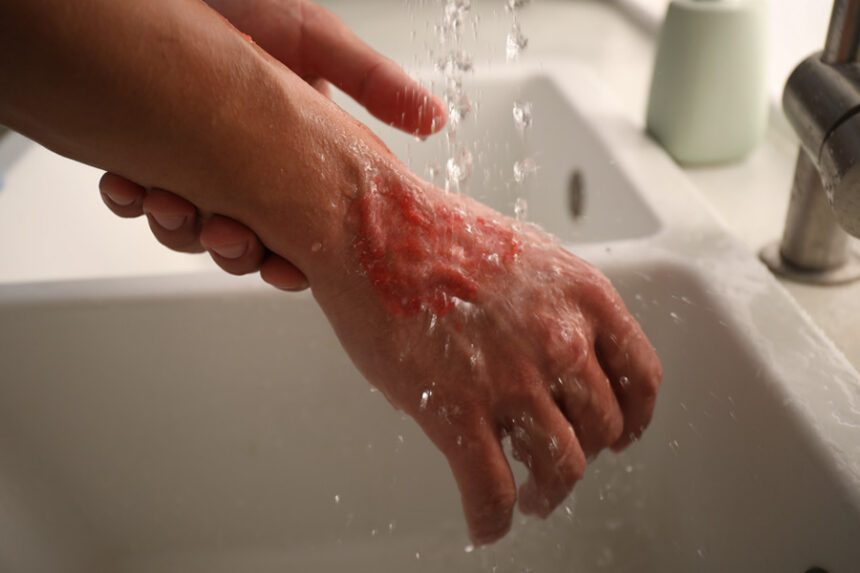
“A second-degree burn has blisters, either intact or broken open and leaking pale, watery fluid,” Miller says. “These might take longer to heal, depending on how deeply into the dermis it is.”
If the burn has gone all the way through the dermis, that’s a third-degree burn.
“Instead of being moist and blistered, it will be, counterintuitively, dry and leathery, because the heat was high enough to take away all the moisture,” Miller says. “It will also hurt less, because the nerve endings in the dermis are wiped out.”
These burns require professional medical care, have a longer healing time and are at higher risk of infection.
Some classification systems recognize fourth-degree burns, which are catastrophic burns that go beyond the skin into the fat, muscle and tissue.
When to Seek Emergency Care for a Burn
Many second-degree burns and all third-degree burns should be seen by a healthcare professional, but depth is only one thing to consider when you’re deciding whether to get emergency care for your burn.
“Both depth and size matter,” Miller says. “Is it a blister the size of a quarter or is it covering your entire thigh because you’ve spilled a pot of pasta water?”
If the burn is larger than five percent of your body, you should go to the emergency department. The size of your palm plus your fingers, held together, represents about one percent of your total body surface area (if a child was burned, use their hand for sizing).
Location is also a factor.
“We’re more concerned about burns to the face and neck, hands, feet, genitalia, and those that happen at the joints—across the wrist, elbow, shoulder, ankle, knee or hip,” Miller says. “When burns heal, the skin tightens, which can impair mobility or affect function.”
Overall health of the person who was burned matters, too; a healthy adult with a small second-degree burn may be fine, but that same burn on a baby, a person older than 65, or a person with underlying health conditions that affect wound healing (such as diabetes, cancer or vascular disease) will be more serious.
Lastly, any burn that happens as a result of chemical exposure, electrical injury or major fire should be seen by a doctor. These types of burns might cause more serious injuries beyond what you can see.
How to Treat a Burn at Home
If you’re dealing with a minor burn that can be treated at home, here’s what to do.
Step No. 1: Stop the burning.
If something hot has spilled on you or a child, you’ll want to minimize the amount of skin burned.
“Let’s say a toddler has come into the kitchen and pulled down a pot of hot soup on themselves,” Miller says. “Take off their clothes and use water to rinse off the hot soup. That extinguishes the heat source and stops the heat transfer.”
Step No. 2: Look for other injuries.
Burns cause chaos. Take a moment to assess if your toddler hit their head when they pulled that pot of soup down or if you’ve twisted your ankle when you reacted to touching something hot.
Step No. 3: Start pain relief.
If you’ve decided to treat your burn at home, reach for an over-the-counter pain reliever such as acetaminophen or ibuprofen.
“These take a few minutes to start working, so try to take pain relievers as soon as possible,” Miller says.
Step No. 4: Wash the wound.
Here’s one of the reasons you want to take a pain reliever as soon as possible: This step will hurt.
“Clean the wound with warm water and soap,” Miller says. “Any soap is fine, it doesn’t have to be antibacterial, but cleaning it reduces the risk of infection. The water should be warm, but not hot.”
Step No. 5: Use cool, running water for pain relief.
Once the wound is clean, change your water temperature from warm to cool, but not cold.
“Using cool running water or a cool compress for 20 minutes will provide pain relief and lessen the inflammation response to the wound,” Miller says. “Don’t do it for longer than 20 minutes or with water that’s cold—and don’t use ice—because these will make the person’s skin too cold, which doesn’t help.”
You may have experienced old family remedies like putting butter on a burn, but don’t continue them.
“The most common mistake is applying a condiment,” Miller says. “People use mayonnaise, toothpaste, butter, Crisco, tobacco. It increases the risk of infection and there’s no evidence to suggest any of these will heal the wound.”
The only exception, Miller says, is medical-grade honey, also known as manuka honey, which can help accelerate healing for first- and second-degree burns. Don’t use any other type of honey on a wound.
Step No. 6: Bandage the burn.
To bandage the burn, you’ll need three things: an antibiotic ointment such as bacitracin, petroleum gauze and cotton gauze.
Apply the antibiotic ointment to the burn. If the wound is too painful to touch, apply it to the petroleum gauze, and then put the part with the antibiotic ointment onto your wound.
“Using petroleum gauze is important because it won’t stick to the wound and will come off easily,” Miller says. “If you don’t have petroleum gauze, which is a few bucks at the drug store, you can use regular gauze and mix a bit of Vaseline into it.”
After you’ve applied the petroleum gauze, add the cotton gauze on top to hold everything in place and keep the wound clean and protected.
You don’t need to bandage a first-degree burn, and some small facial burns may be difficult to bandage. In that instance, apply the ointment to the burn several times a day, making sure that it’s moist but not goopy.
What to Watch for When a Burn is Healing
Change the bandage on your burn once a day; your shower or bath is a good time to wash the wound and reapply the ointment and gauze.
“The wound might look a little nasty from the drainage for a few days,” Miller says. “If that drainage starts to smell, or it’s any color but clear or pale yellow, it might be an infection. Redness or swelling around the wound, pain that’s increasing rather than decreasing, or flu-like symptoms of fever and chills are also signs of infection.”
If you have any sign of infection, contact your doctor or visit urgent care or the emergency department.
Burns will take various amounts of time to heal, depending on depth and size; continue to bandage the burn as long as it’s an open wound or moist from fluid so that bacteria and dirt don’t get into it. Once you see that a new layer of skin has covered the wound, and it’s no longer moist, you can stop bandaging and leave the skin exposed to the air. You’ll still want to apply a thin layer of plain moisturizer to the newly healed skin.
“As the skin heals, we want it to be supple, not tight, so gently massage a small amount of moisturizer or lotion into the skin,” Miller says. “If the skin heals in a tightened position, the wound can reopen when it stretches, so moisturize several times each day, and if it’s around a joint, gently move the joint around.”
As your burn heals, it might start to itch.
“Scratching will disrupt wound healing and introduce bacteria and germs,” Miller says. “You can fool your body and reduce the sensation of itching by applying pressure nearby. Moisturizing and gentle massage can help. For persistent itching, consider an over-the-counter oral antihistamine such as Zyrtec.”
Though the wound will heal, that area of skin will always need a little extra attention.
“Skin that has been burned is always at greater risk of sunburn, so take extra care and use sunscreen,” Miller says.
Questions about wound care? Talk to your doctor or find one near you.