
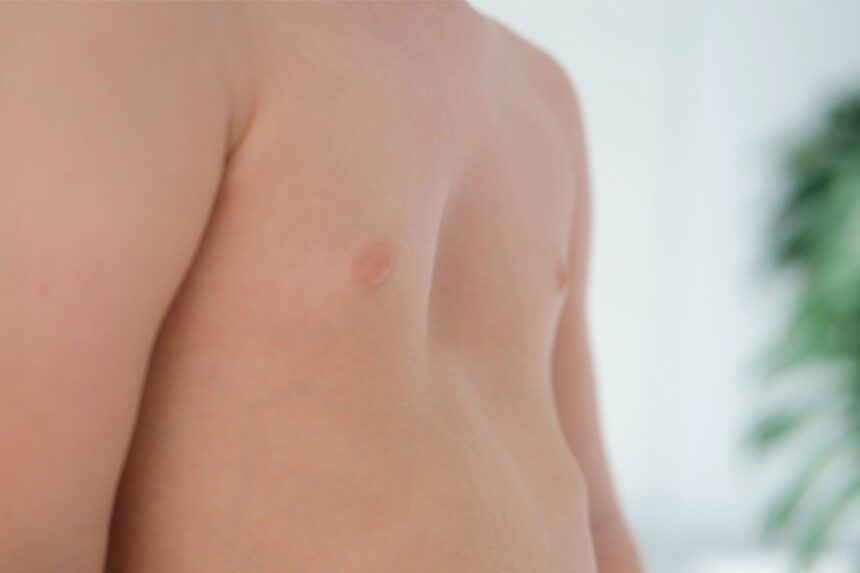
You’re changing your new baby’s diaper and notice a sunken spot in the middle of their chest.
Or you look at your 13-year-old son at the pool and wonder, is that a dent in his sternum?
Only your doctor can say for sure, but it could be pectus excavatum, a chest wall deformity in which the sternum grows inward, resulting in a dent or what’s sometimes called “funnel chest.” Pectus excavatum occurs in about 1 in 400 births and is five times more common in boys than girls.
“Sometimes, the parents or pediatrician will recognize a depression in the chest at birth, but it becomes more apparent when a child goes through a growth spurt, so it’s often recognized in kids at adolescence,” says UNC Health pediatric surgeon Sean McLean, MD. “As cartilage grows in an abnormal fashion, it can become more severe, both visibly and in consequences for the heart and lungs.”
Once recognized, it’s important for a child to be evaluated by a pediatric surgeon familiar with chest wall deformities, Dr. McLean says.
Symptoms and Complications of Pectus Excavatum
As the bones of the sternum grow inward, they can affect the lungs and the heart.
“Children report shortness of breath at rest if it’s severe, or they may notice changes in their exercise tolerance,” Dr. McLean says. “Maybe last year they could play for hours without having to rest, but now they’re noticing they have to take more frequent breaks despite maintaining all other conditioning.”
Pectus excavatum can cause abnormal or irregular heart rhythms. A child may notice that their heart is beating more quickly or pounding. Sometimes, the heart won’t be able to pump enough blood to the rest of the body so that the child feels faint or dizzy. Some children have short runs of abnormal heart rhythms, and if those become sustained and are left untreated, they can lead to cardiac arrest.
Pectus excavatum may cause chest pain because of the sternum’s abnormal position and the abnormal position of the cartilage.
Children may not always notice these symptoms, particularly if they’re not playing a sport or exercising vigorously, which is why you shouldn’t wait for symptoms to appear before seeing a doctor about pectus excavatum. It’s also important to consider potential impact to their mental health.
“Children also have body image issues and negative feelings about how their chest wall looks,” Dr. McLean says. “Social withdrawal and depression are documented consequences.”
Diagnosing and Monitoring Pectus Excavatum
While it may be easy to see and diagnose a child’s chest wall deformity visually, it’s important that children have additional testing once pectus excavatum is identified.
“There is a link with several connective tissue disorders, notably Marfan syndrome, that can have other severe consequences, so we always screen for those,” Dr. McLean says.
Marfan syndrome is a rare genetic condition that can cause other skeletal issues, eye problems and heart complications.
Your doctor will order a CT scan to determine the depth of the depression of the sternum and whether it’s putting pressure on the heart. This may be an ongoing test as your child grows to determine what changes are happening over time.
Your child’s doctor may perform heart tests—electrocardiograms and echocardiograms—to check the heart’s functioning and lung function tests.
“An asymptomatic patient might not be active enough to elicit symptoms, but with pulmonary function stress testing, we can measure whether their airflow is compromised,” Dr. McLean says. “Some patients do remain asymptomatic, with no significant effects to the heart or lungs, but many have some exercise intolerance as their main complaint.”
Ongoing monitoring is important because there is an ideal window for a minimally invasive surgical treatment. Your surgeon can help you decide when surgery is necessary.
Surgery for Pectus Excavatum
Before puberty and its related growth spurts, a child with pectus excavatum will still be encouraged to be active, but it will be important for them to take breaks and be mindful of their breathing.
For children having symptoms before puberty, there is something called the vacuum bell technique: a cup or bell is placed on the child’s chest, and you use a pump to create suction that temporarily pulls the sternum up.
“It’s not correcting the problem, but it can temporarily decrease the depth of the sternum,” Dr. McLean says. “It must be done every day, and when you stop use, the sternum will often resume the previous position.”
Some children’s chest walls do not respond to vacuum bell technique, Dr. McLean says, and depending on the depth of the sternum, the effect might be very minor.
To correct the deformity, there are two main surgical options: the Nuss procedure, a minimally invasive approach, and the Ravitch procedure, which requires open surgery.
For the Nuss procedure, the goal is to operate during the adolescent growth spurt, when the chest wall is still flexible enough to respond to the treatment but developed enough that it won’t start growing inward again after the bar is removed. For boys, that’s typically between 14 and 16 years of age; for girls, the ideal is between 13 and 15, Dr. McLean says.
During the Nuss procedure, a small incision is made on each side of a child’s chest. A small camera is temporarily placed inside, and the surgeon applies analgesic to the chest nerves to help with post-operative pain. Then a curved metal bar is placed through the incision, across the chest, and secured with sutures around the ribs.
“The chest wall remodels over time because of the forces the bar creates,” Dr. McLean says. “The bar is left in place for two or three years, and then it comes out with a same-day surgery. We just have to make one small incision to remove it.”
The older Ravitch procedure might be used when the depression in the chest is asymmetric or off-center. It might be necessary for adults who are no longer good candidates for the Nuss procedure.
During the Ravitch, doctors make an incision across the chest and move the muscle and cartilage to access the sternum. Any abnormal cartilage is removed and the sternum is repositioned into place and stabilized with plates or bars. This procedure typically requires more days in the hospital and a longer recovery compared to the Nuss procedure.
Both procedures relieve pressure on the heart and lungs.
“Some kids report that it’s easier to breathe immediately after surgery,” Dr. McLean says.
It’s important that kids refrain from activity for the first two weeks after surgery. Following the Nuss procedure, it’s OK to start walking longer distances and lifting light objects, and most kids are cleared to go back to school between two and four weeks, though they will not be able to do PE or sports initially (the timeline is usually longer for the Ravitch procedure).
“By six weeks, the body will gradually get stronger and regain its conditioning,” Dr. McLean says. “We also must assess for weakness in the upper extremities, and physical therapy might be required a few weeks after surgery to regain that strength and range of motion in the upper extremities because of lack of use.”
By the two-month mark, an athlete might be cleared to start individual training, and they might be allowed to play at three months.
“They can’t participate in activities where there is significant risk of collisions or falls, so no tackle football or riding ATVs, but by three months, most kids are almost back at the level of conditioning they were at prior to surgery, with recovery of their strength, a full range of motion and improved lung performance,” Dr. McLean says.
If you’re concerned about your child’s health, talk to their doctor. If you need a doctor, find one near you.