
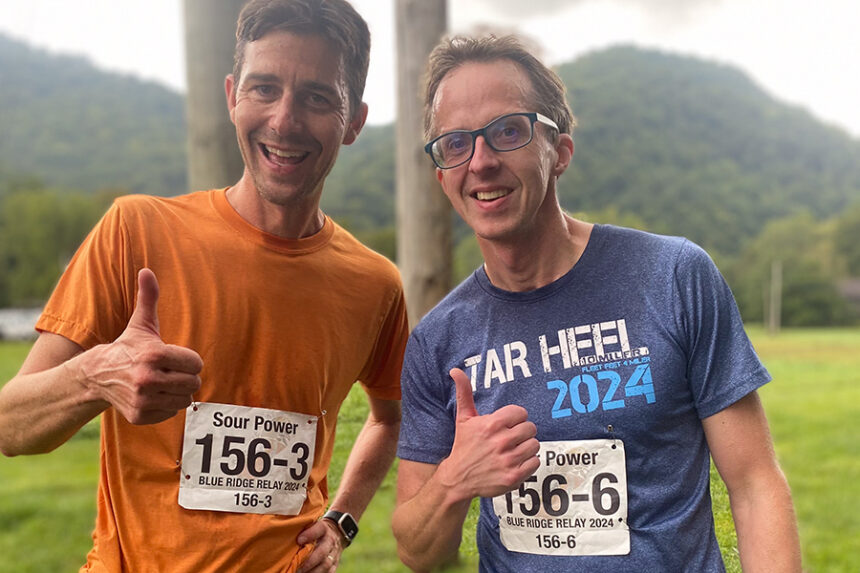
As a UNC Health physician who specializes in hospital medicine, Michael Craig, MD, MPH, has seen a lot of people after they’ve had a stroke. He didn’t expect to experience one himself when he was just 44 years old.
“In 2023, I went out for a jog, and about half a mile from my house, I realized I couldn’t bear weight on my left leg, and I fell,” Dr. Craig says. “I thought I sprained my ankle, which I had. Then I realized I couldn’t roll over on to my back.”
Not being able to move left Dr. Craig confused, which UNC Health neurologist Dena Williams, DO, says is a common reaction to a stroke.
“It really is like going from zero to 60 miles per hour in a split second,” Dr. Williams says. “It can be hard to grasp that something has happened to you because it happened so fast.”
Fortunately, one of Dr. Craig’s neighbors saw him fall and rushed out to help.
Going From a Jog to the Emergency Department
Dr. Craig’s neighbor noticed that he was slurring his words and called 911, which was exactly the right move.
“Symptoms of a stroke can be really subtle, which is why too many people wait too long to come in,” says Dr. Williams, who was on-call in the hospital the day Dr. Craig had the stroke. “If there’s any concern that something is not right, call 911 so the person can be evaluated and get treatment.”
The most common signs of a stroke are difficulty maintaining balance, sudden vision changes, a numb or drooping face, an arm or leg feeling weaker on one side of your body and difficulties speaking or understanding speech.
It’s important to remember that strokes can happen to anyone; on paper, Dr. Craig wasn’t at high risk for a stroke given his age (the risk of having a stroke doubles every decade after the age of 55) and his active lifestyle, which included running half marathons.
“I don’t think the realization really kicked in until I was getting a thrombectomy, a clot extraction, from the neurosurgeon,” Dr. Craig says; he first received intravenous thrombolytic medication to break up clots. Both treatments must be administered within a certain window of time—another reason why it’s so important not to wait to go to the emergency department.
Dr. Craig received quick treatment, but it wasn’t until that night in the intensive care unit and in the days afterward that he realized how weak he was on his left side. He was experiencing left-side neglect, an effect of stroke in which people aren’t just weak on one side, but they lack awareness of that side to the point that they don’t realize they’re not using it. While he had originally anticipated being able to go home quickly because he felt well after treatment, deep fatigue set in.
Individualized Rehabilitation Focuses on Work and Play
After a person receives stroke treatment, their care team begins planning for rehabilitation and trying to find out why the stroke happened so that another stroke can be prevented.
For some people, that may mean addressing their cholesterol, blood sugar, blood pressure or smoking habit. For Dr. Craig, it meant finding out that he had a congenital heart issue called an atrial septal defect, a small opening in the heart, which likely contributed to the stroke.
While these defects don’t always require treatment, Dr. Craig had a heart catheterization procedure to successfully close the opening. First, he spent two weeks at the UNC Rehabilitation Center in Hillsborough for inpatient recovery.
“I could not walk at all when I got there because of the sprained ankle and left-sided weakness,” Dr. Craig says. “The rehab was aggressive, but I was incredibly impressed with how individualized everything was for me. I did physical therapy to work on balance and strength and occupational therapy to work on weakness in my left hand. By the time I left, I could walk and go up and down stairs.”
Dr. Craig’s inpatient physical therapist connected him to another physical therapist who specializes in returning to running after strokes.
“I really had to focus on balance and learn how to adjust when I was on a long run or when I could feel myself getting tired,” he says. “When I finally got to do my first solo run, I did a really basic circle around the neighborhood, but just being able to do it on my own was pretty powerful.”
Dr. Craig’s stroke was in October; by the following April, he was able to run the Tar Heel 10 Miler.
Dr. Craig also had inpatient and outpatient speech therapy, which focused on ensuring he was able to perform his job to the highest standard.
“It was about making sure I could write notes, interpret clinical findings, give a presentation,” he says. “I had a lot of cognitive testing, learned how to manage fatigue and worked to make sure it was safe before returning to work.”
Advice for Others: “A Marathon, Not a Sprint”
The ability to run a 10-mile race six months after a stroke might make it seem like Dr. Craig had a quick recovery, but both he and Dr. Williams say that patience is necessary.
“We have to remind people that it’s a marathon, not a sprint,” Dr. Willliams says. “It can take a good 12 months to see recovery, and even after that, it will take some work and effort. People might also have mood changes and fatigue to deal with.”
Dr. Craig says fatigue has been one of the most difficult parts for him.
“When people see me walking, they think I’m 100 percent better,” Dr. Craig says. “They don’t see the times I’ve struggled with fatigue or trying to talk when I’m at home.”
While Dr. Craig has been able to continue his work and athletic hobbies, including kayaking, he said there have been other changes.
“I was probably spending too much time at work and ignoring some parts of my health,” he says. “Now, my wife calls me Mike 2.0, because I put more focus into my marriage and my relationship with my kids. The stroke did bring into focus that I needed to change my priorities.”
If you’re concerned about your risk for stroke, talk to your doctor. If you need a doctor, find one near you.