
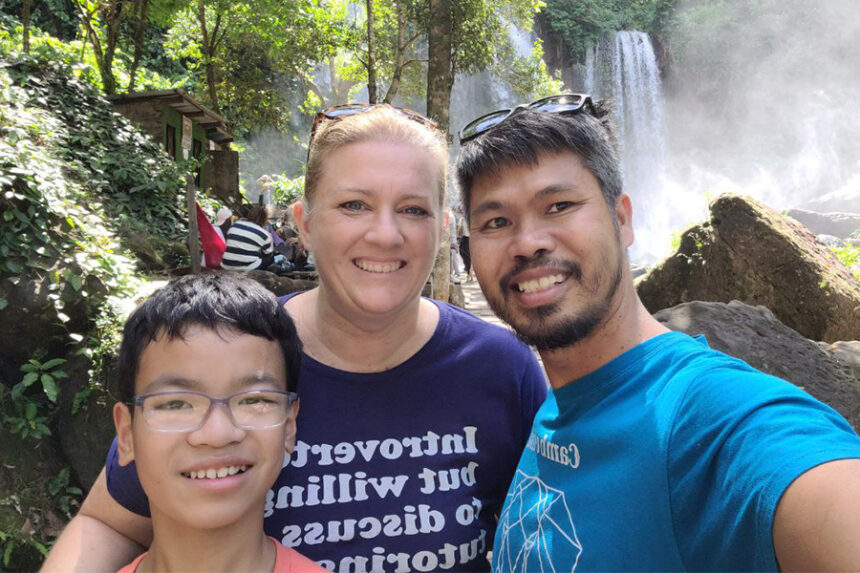
When Jenn and Damson Huon adopted their son, Bohao, from China in February 2018, they knew he had a speech delay and was his small for his age. What no one knew was that the then-6-year-old had epilepsy.
“He slept in a room with 25 other kids, and he’d most likely been having seizures his entire life,” Jenn Huon says. “Because his nighttime seizures weren’t loud or violent, no one realized.”
Today, Bohao is 14 and loves riding his scooter, being outside, meeting new people and traveling with his parents to Cambodia, where they live part-time as missionaries. A few years ago, that’s not a future his parents could have imagined for him, as doctors worked to find a way to address his ever-increasing seizures.
“It felt like we were watching him slowly drift away, and I didn’t know if a person could survive that many seizures,” Huon says. “But the doctors never stopped trying, and brain surgery made a huge difference to where he is now.”
Huon and UNC Health pediatric neurologist Qian-Zhou (JoJo) Yang, MD, explain Bohao’s journey.
A Search for the Right Medication
Three months after Bohao’s parents brought him home, his mother went to check on him one morning and found him in bed staring off into space, dazed and unresponsive. He started convulsing, and she called 911.
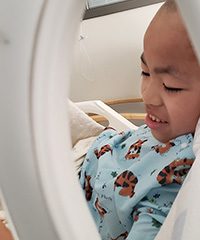
The paramedics recommended the epilepsy specialists at UNC Children’s. Four days in the hospital and lots of testing were just the start of what would become years of treatment for Bohao’s epilepsy.
“He’d be put on a medication and would do well for six months, and then he’d start having seizures again,” Huon says. “It was the beginning of a downward spiral. He started having more seizures and longer seizures, and those are signs that medications aren’t working.”
In addition to not controlling the seizures, Huon says the medications often caused difficult side effects, such as weight gain and aggression.
While at first Bohao’s seizures were mostly at night, they started happening around the clock, becoming longer and more frequent.
“It got to where we couldn’t go anywhere, because he was having constant seizures, and I was on edge,” Huon says. “There were a lot of nights I didn’t sleep because I was running to his bedroom and turning into an emergency medical worker. It rips your heart out.”
As time passed, Bohao’s seizures would move and start in different places in the brain.
“When you have a child with medication-resistant epilepsy, which means seizures aren’t controlled after trying two or more medications, it’s important to look at non-medication options, such as surgery,” Dr. Yang says.
With most surgeries for epilepsy, surgeons try to target the specific place where seizures start; in Bohao’s case, Dr. Yang and team recommended a relatively new surgical option for pediatric epilepsy: deep brain stimulation, which would prevent Bohao’s brain from creating new seizure pathways.
“Seizure networks can grow and cement in the brain over time,” Dr. Yang says. “We have a critical window of time of three to eight years of uncontrolled seizures to intervene with surgical options to allow the best outcome.”
Without intervention, the seizures become harder to treat and can lead to more seizures and loss of body functions.
Deep Brain Stimulation for Pediatric Epilepsy
Bohao was becoming nonfunctional, losing the ability to speak or interact. That didn’t make the decision to put him through brain surgery easy for his parents.
“As parents, the decision was on us, not him, and you don’t want to make a mistake for him,” Huon says. “I trusted the doctors, but I didn’t always trust my decision, and it was one of the hardest things I’ve ever been through.”
Deep brain stimulation is often used for conditions such as Parkinson’s disease or essential tremor, but its use in pediatric epilepsy is new. Bohao would be the first child to receive the treatment at UNC.
“For Bohao, we couldn’t treat each little area where seizures were happening individually,” Dr. Yang says. Instead, “we can put a stimulator on each side of the brain in the thalamus, which is like a highway hub where all the brain connections pass through. When the device stimulates the thalamus with an electrical current, it targets all those seizure networks in the brain and stops the activity.”
Implanting the device involved putting electrodes in his brain and a battery pack in his chest, in the same location where cardiac pacemakers go. The surgery was in April 2023.
“We could immediately see a difference,” Huon says. “He loves to dance, and three days after surgery, there was some music on the television, and he started to dance. Those little moments give you encouragement.”
Huon says in a matter of days, she saw his personality come back. He started talking more and laughing again.
He’s been seizure-free since the surgery.
Bohao still has to take some medications, but for some children, surgery can reduce or eliminate the need for them.
“When you take medications by mouth, they can have side effects for the whole body,” Dr. Yang says. “I know surgery feels very invasive and daunting to many families, but it treats the root cause of the problem, and in the long term, it decreases the medication burden.”
Enjoying Moments Big and Small
Bohao has special needs, and years of near-constant seizures hindered his ability to learn. But since the surgery, Huon and Dr. Yang have seen important cognitive improvements.
“He’s only at a 7-year-old learning level, but you can’t teach a kid who is having seizures,” Huon says. “Now, his thinking abilities and processing is much better. He’s catching on to things he was never able to understand before and saying new words for the first time.”
Daily life has improved for the entire family as Bohao is able to do more tasks independently, thanks to physical therapy and occupational therapy.
“We used to have to do everything for him—brush his teeth, wash him, toileting,” Huon says. “Now he can do all those things. He can make his little breakfast and clean his own room as well as a kid can do. I don’t think I realized how tense I was all the time until after the surgery. It’s a more normal life, and it feels good to be normal.”
Huon says there are still many unknowns for Bohao. Given his type of epilepsy, seizures may return and he may need additional surgery at some point. Because of his special needs, he will likely never live on his own. Still, she’s appreciating small pockets of normalcy as they come.
“Right now, he can be a plain old kid who loves riding his scooter, going to the playground and hiking,” Huon says. “He loves to build things and is very creative. Just the other day, he worked with his dad to fix his scooter. When you have those little moments with your child, they’re a victory.”
If you have questions about your child’s health, talk to their doctor. If you need a doctor, find one near you.