
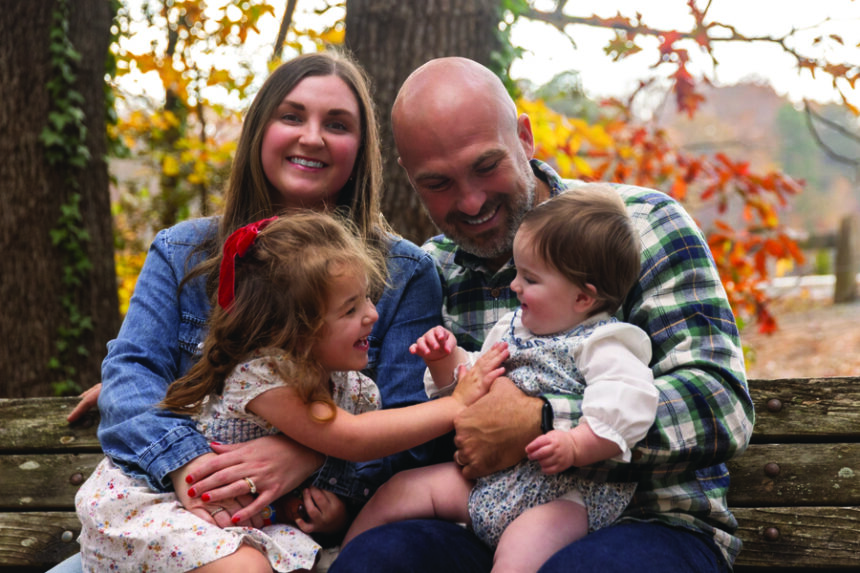
Emily Sliwinski, now 33, did not have an easy start to motherhood.
“It was a traumatic birth,” she says of the 2022 delivery of her daughter. “I went unmedicated and needed an episiotomy and a vacuum delivery. There was trauma to my body that I wasn’t fully aware of at the time.”
Her daughter required a few extra days of hospitalization for jaundice, which was also difficult. But once the family was home in Greensboro, North Carolina, things didn’t get better.
“About a week later, I had a debilitating migraine,” Sliwinski remembers. “I got medication from my obstetrician, but then things turned. I was not coping well. My mind was racing. I couldn’t quiet my thoughts, and I couldn’t sleep.”
Sliwinski had support; she describes her husband as hands-on and her mom, a NICU nurse, was there to help her. When she continued to struggle, they encouraged her to seek treatment at the emergency department, hoping she could get medication to help her sleep and for anxiety.
Instead, Sliwinski was misdiagnosed with schizophrenia, hospitalized for almost two weeks and separated from her new baby.
“I feel like this is someone else’s story, but it happened to me,” Sliwinski says. “My brain went on a hiatus, and there was nothing I could do about it.”
Here’s how Sliwinski got better, with the help of UNC’s Perinatal Psychiatry Inpatient Unit.
Misdiagnosed with Schizophrenia and Away From Her Baby
Sliwinski’s family encouraged her to go to the emergency department because they were concerned about her behavior in the days after that migraine.
“I was obsessed with solving the national formula crisis and had a bulletin board of ways that I was going to reach out to moms,” Sliwinski says. “I thought my dog was speaking to me. I asked my mom if I had missed my sister’s birthday, which was two weeks away, and my mind was racing to the point that I was having my husband quiz me. I was getting agitated and difficult to deal with.”
When she got to the emergency department, Sliwinski panicked and wanted to leave.
“I feel the worst about this part, but it’s important: I slapped my mom across the face,” Sliwinski says. “I also hit my husband. That’s not me, not my normal behavior. They admitted me by determining I was a danger to myself and others.”
Sliwinski was in the emergency department for two nights before being transferred to a behavioral hospital in Greensboro. They began treating her for schizophrenia, which can cause hallucinations, delusions and confused thinking.
“I had 14 medications, antipsychotics, and I wasn’t getting any better,” Sliwinski says. “My family wasn’t able to visit. The notes said I was yelling and screaming, which is so uncharacteristic of me.”
Meanwhile, Sliwinski’s family was trying to find a better option. Through Postpartum Support International, they learned about UNC’s Perinatal Psychiatry Inpatient Unit, or PPIU. Sliwinski’s obstetrician helped provide a referral, and Sliwinski was approved for one of the five available beds.
Postpartum Psychosis Care at the PPIU
Sliwinski was transported from Greensboro to UNC Hospitals in Chapel Hill in a van with security features.
“There’s the shield to protect the driver from the patients,” Sliwinski says. “I remember them saying that they didn’t think I needed handcuffs. I felt like I had gone through hell.”
When she arrived at the PPIU, the difference was immediate.
“I went from feeling like I was in prison to being treated like a person, like a mom who had just had a baby,” Sliwinski says.
That’s by design. Founded in 2011, UNC’s PPIU was the first unit of its kind in the United States to treat women in crisis during a reproductive health transition. That’s usually pregnancy or the postpartum period, says Riah Patterson, MD, director of the unit, but it can also help women struggling with menstrual mood disorders, perimenopause and menopause. Care is provided by doctors, nurses, psychologists, social workers and other therapists who specialize in women’s mood disorders.
The first step for Sliwinski, as it is for all patients, was an individualized treatment plan.
“The first day is intense, because you meet with all the treatment team members—psychiatrists, psychologists, the occupational therapist, the recreational therapist,” Dr. Patterson says. “There may be medication changes. There’s both individual and group therapy that’s specific to what the patient and their loved ones have identified as top priorities.”
Sliwinski’s doctors suspected postpartum psychosis, which is characterized by delusions, hallucinations, mood swings and sleep disturbances.
“The doctor told me that you don’t wake up one day with schizophrenia,” Sliwinski says. “They switched me to lithium right away, which is the gold standard treatment for postpartum psychosis.”
Over the next eight days, Sliwinski was monitored as she adjusted to the medication and attended therapy sessions and group activities. Depending on their situation, women in the PPIU may learn a wide range of coping strategies, including how to identify support people and systems, how to communicate their needs, and how to find time for exercise, sleep and leisure. There is also music therapy, a spirituality group and flex time for rest, art, journaling and therapy assignments.
One major difference between the PPIU and other inpatient psychiatric units is that moms can visit with their children, either in-person or virtually, at specific times.
“On other inpatient units, where people might be dealing with substance issues or other psychiatric illnesses, it’s usually not safe for young kids,” Dr. Patterson says. “Here, moms can interact with their children in a safe, targeted way. We can observe interactions and give feedback. Sometimes, when a mom is depressed or anxious, she can’t see everything that’s going well, so we point that out.”
The unit also provides access to a lactation consultant, areas to nurse or pump and accessible refrigeration for breast milk.
“It was hard to be away from my baby for weeks of her life, but it was really important as a mom to be able to try to pump,” Sliwinski says. “Knowing my baby was at home was motivating, because I knew I needed to get home to her.”
Dr. Patterson says that’s the goal.
“The need to go into a hospital and separate from your family is scary and challenging,” she says. “It can be uncomfortable to lose your autonomy and have everyday things, like your cell phone or ability to go outside, taken away from you. But the goal is to resolve the crisis and get back to yourself as quickly as possible.”
A “Redemptive” Birth of Her Second Child

Dr. Patterson says that the average length of stay in the PPIU is seven days, depending on the patient’s needs. Sliwinski was discharged after eight days and started intensive outpatient therapy three times a week. She remained stable on lithium and continued taking it through her pregnancy with her second daughter, born in March 2025.
“I had a positive experience with my second birth,” she says. “That was very redemptive. I had a peaceful, wonderful postpartum experience.”
That second birth of a healthy baby who started to walk at 10 months to keep up with her big sister inspired Sliwinski to share her experience with postpartum psychosis and the PPIU to give others hope.
“I never knew about postpartum psychosis, and it happens more than we know,” she says.
Postpartum psychosis affects between 1 and 2 in 1,000 postpartum women. Other perinatal mood disorders are more common; for example, depression affects as many as 1 in 7 women during pregnancy or the postpartum period.
Pregnant and postpartum women should be on the lookout for changes in mental status, changes in usual beliefs or behaviors, or a new level of confusion or cognitive impairment, Dr. Patterson says.
“Anytime you’re not feeling like yourself, that should be a big alarm,” Dr. Patterson says. “It often happens soon after delivery, because there are so many hormonal changes, but it can also happen a year out from delivery, sometimes when a baby is weaning from breastfeeding.”
The one-year mark is a particularly vulnerable time for women, Dr. Patterson says, with a high risk for suicide, because women may not be seeing their OB/GYN or their child’s pediatrician as frequently as in earlier months; these providers help to screen for psychiatric disorders.
“So many women struggle for a long time, thinking it’s just baby blues,” Dr. Patterson says. “These are illnesses that are treatable.”
Not every incidence of postpartum depression requires inpatient care, but for those that do, Dr. Patterson says that they are often able to accommodate referrals to the PPIU within a week.
“There’s a lot of magic in having specialized physicians and therapists who understand these transitions, and having this experience with the other moms,” Dr. Patterson says. “People realize they’re not alone and that these scary thoughts are not something to feel guilty about.”
That was true for Sliwinski.
“It was life-changing for me,” she says. “If I hadn’t been transferred to UNC, I don’t know where I would be now. I feel very lucky.”
If you’re struggling with your mental health, talk to your doctor. Need a doctor? Find one near you.