
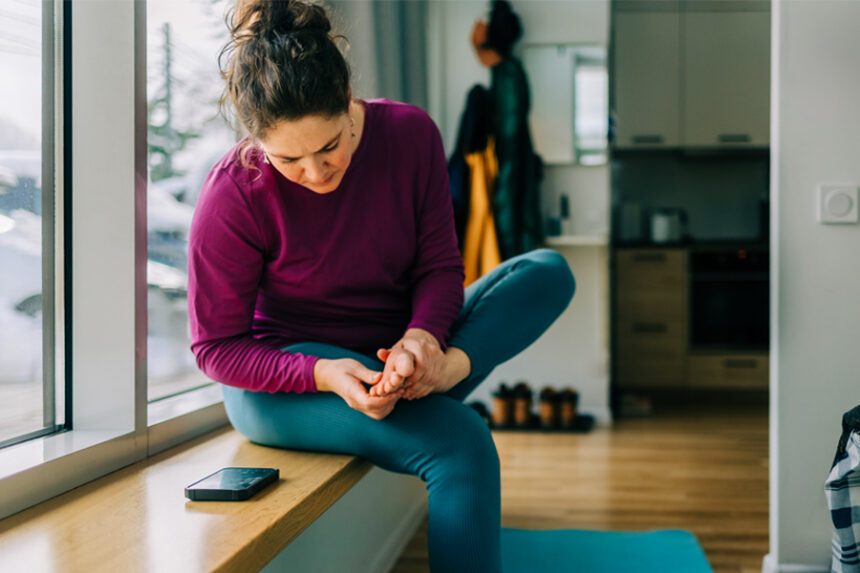
When you notice a skin issue on your foot, you might be tempted to put your shoes on and forget about it, especially if it’s not affecting your ability to move. That would be a mistake.
“People take their feet for granted, until they can’t walk,” says UNC Health podiatrist Howard Kashefsky, DPM. “When foot problems are neglected, they can get worse over time, so take the health of the skin on your feet seriously.”
You may be able to treat common foot skin issues with over-the-counter remedies available at your local pharmacy. There are, however, some exceptions.
“If you have a condition that causes nerve damage or decreased blood flow, such as diabetes or a vascular issue, or you’re immunocompromised, only treat your feet under physician supervision,” Dr. Kashefsky says. Ask your primary care provider about whether your feet need extra attention due to a preexisting condition. “You may be at increased risk for poor wound healing and could have complications.”
Warts
Warts are noncancerous bumps that can develop anywhere on your body, including your hands and face. You may also notice them on various parts of your foot, including the soles, heels, under or between your toes, or even the top of the foot. They can cause pain, but not always.
Warts are caused by the human papillomavirus (HPV), though not the same strain of the virus that causes genital warts or cervical cancer.
“Because they’re caused by a virus, they can spread between people,” Dr. Kashefsky says. “If you share a shower with family members, spray diluted bleach in the tub after your shower.”
You can treat a wart with an over-the-counter wart remover; if this doesn’t work, talk to your primary care provider about options for removing it, such as freezing or cutting it off.
The risk of warts is one of the reasons it’s important to wear shoes in public places.
“If you’re at a community pool or showering at the gym, it’s important to wear something protective when you walk, like water shoes or a flip-flop with a good base,” Dr. Kashefsky says.
Blisters
You’re excited to wear your new pair of shoes, but hours later, you start feeling the pain of new blisters, or fluid-filled bubbles of skin on your feet.
“Blisters are caused by friction, usually from poorly fitted shoes,” Dr. Kashefsky says. “You may not have bought the right size shoes, or you may have an abnormally shaped foot that makes finding shoes that fit difficult.”
You can prevent blisters by getting your feet measured; a running shoe store will be able to help. Good quality socks can also make a difference. Dr. Kashefsky recommends seamless socks made of a moisture-wicking fabric, which will cause less friction within your shoe. If you’re prone to blisters, you could also try an over-the-counter anti-friction balm or gel designed for the feet.
If you have a blister, don’t pick at it or try to pop it yourself.
“Keep the area clean and try to rest so it can heal,” Dr. Kashefsky says. “You can use over-the-counter blister creams, and these should improve in a few days. If they don’t, talk to your primary care provider.”
Calluses
Calluses form from a combination of friction and pressure, which is why they appear at weight-bearing areas, like the ball and heel. They may also be on parts of the toe that rub up against your shoes.
“The body’s natural response to this pressure is protective, so it forms thicker, harder skin in the shape of a callus,” Dr. Kashefsky says.
A corn is a type of small, round callus that usually appears on the toes.
If you don’t have any other risk factors that would affect wound healing on your feet, you can treat a callus or corn by applying an over-the-counter cream that has at least 20 percent urea, which helps to break down the harder skin.
After a shower or bath, you can gently rub a pumice stone on the bump to exfoliate that skin. Stop if you feel pain when you rub the callus or draw blood and talk to your primary care provider about whether it should be professionally trimmed.
Some people may get calluses because of a structural issue with their foot, such as flat feet, high arches or bunions (bony bumps on the toes).
“If there’s an underlying cause, you might need different shoes or something to go inside the shoe to reduce pressure, like an over-the-counter or custom orthotic,” Dr. Kashefsky says. “If there’s pain associated with the callus, tell your doctor; they may want to consider a deeper issue inside the foot, like damage to the tissues.”
In some cases, surgery is considered if there’s a structural deformity causing the problem.
Athlete’s Foot
Here’s another reason to wear shoes in public spaces: tinea pedis, more commonly known as athlete’s foot, a fungal infection that causes a rash.
“Athlete’s foot is caused by fungal organisms that are very prevalent in the environment—they’re on most surfaces and in the soil,” Dr. Kashefsky says. “Some people are more prone to it than others, for reasons we don’t understand. Some people get athlete’s foot after one exposure; some people are exposed all the time and never get it.”
Athlete’s foot typically starts between the toes or on the side of the foot with cracked, flaking and peeling skin. The skin may turn red and itch, and eventually, you can have burning or stinging and blisters.
“It can spread on the skin and into the nails, and once the fungus is in the nails, it’s more difficult to treat,” Dr. Kashefsky says. “If you have a crack or break in your skin’s natural barrier, you can get a secondary infection in your skin tissue.”
These complications can be especially difficult for people who are immunocompromised; in people with diabetes, it can result in foot amputation.
Avoid these outcomes by using an over-the-counter antifungal cream or powder when you see the first signs of athlete’s foot. If these treatments don’t help, talk to your primary care provider about a prescription antifungal. Don’t share shoes, and don’t store your shoes in a place that creates optimal growing conditions for fungi.
“Don’t put your shoes in dark, warm, moist environments,” Dr. Kashefsky says. “Keep them in sunlit environments where the UV light will kill the spores that can grow in shoes.”
Questions about your foot health? Talk to your doctor. Need a doctor? Find one near you.