
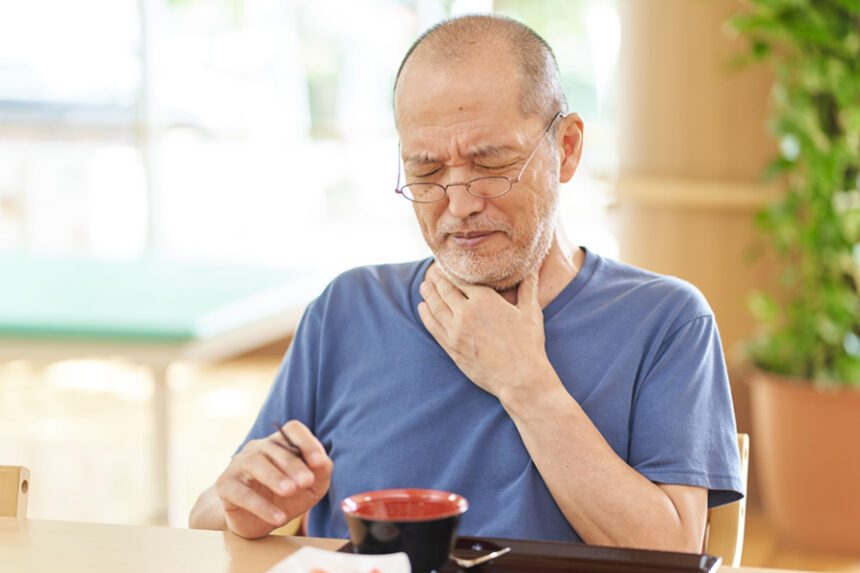
It’s alarming to try to swallow and find you can’t or at least not comfortably. If this keeps happening to you, the cause could be eosinophilic esophagitis, or EoE, a chronic allergic reaction of the esophagus, the tube that connects your throat and stomach.
Once thought of as a rare disease, EoE is now known to affect about 1 in 700 people, which is likely an underestimate, says UNC Health gastroenterologist Evan Dellon, MD, MPH, director of UNC’s Center for Esophageal Diseases and Swallowing (CEDAS).
The foods that may trigger eosinophilic esophagitis are also the most common food allergies—dairy, wheat, eggs, nuts and shellfish—but instead of causing an immediate reaction throughout the body, you get a buildup of white blood cells called eosinophils in your esophagus.
“The eosinophils are a sign of allergic inflammation in the esophagus, and over time, that inflammation leads to scar tissue and strictures that affect your ability to swallow,” Dr. Dellon says. “It feels like food is stuck and can’t get out.”
If untreated, that can cause a tear in the wall of your esophagus, which is why it’s important to know about this condition and seek treatment.
Here’s what else you need to know about EoE.
-
EoE symptoms look different in children and adults.
In kids, EoE can cause food aversion, vomiting, abdominal pain or poor growth, but so do many other conditions, so diagnosis can be tricky. Adolescents and adults with EoE tend to have trouble swallowing, heartburn, and food impaction, a feeling that food is stuck in their throat or chest. Food impaction can sometimes feel like choking.
A lack of awareness about EoE leaves many cases undiagnosed.
“People might think they have acid reflux and treatment doesn’t work for them, or they just get really careful with what they eat to minimize their symptoms,” Dr. Dellon says. “It’s not normal to have to drink water after every bite of food, to have to mash your food up to get it down or to always be the last one at the table. If you’re experiencing that, get checked out.”
-
Most people with EoE have another allergic condition, too.
Some people have an allergic predisposition, Dr. Dellon says.
“Between 60 and 80 percent of people with EoE will have another allergic condition, whether that’s a food or environmental allergy, asthma or eczema,” Dr. Dellon says.
EoE is not caused by particular genes, but it can run in families, and it’s more likely to be found in people who already have an allergic condition.
“We think there are environmental factors that interact with that genetic predisposition,” Dr. Dellon says.
There tend to be more cases in cold climates, rural environments and areas with poor air or water quality. Babies born by cesarean section and those who required early antibiotics or care in the neonatal intensive care unit are also at higher risk for EoE.
Most likely, changes in the environment over time have contributed to the rise in EoE cases.
-
Diagnosing EoE requires an upper endoscopy and biopsies.
The only way to diagnose EoE is with an upper endoscopy, a procedure in which your doctor puts a long, flexible tube through your mouth and down into the top part of your digestive tract (esophagus, stomach and first part of the small bowel). You are typically sedated and asleep for the procedure.
“The esophagus doesn’t look normal if you have EoE; we might see swelling, white spots, scar tissue or rings in the esophagus,” Dr. Dellon says. “We take multiple small biopsies to look for the presence of the eosinophils and other signs of inflammation and scar tissue.”
Biopsies are usually not painful, and that there’s no association between EoE and esophageal cancer, though some symptoms overlap.
While people adapt their eating habits when they have EoE symptoms, Dr. Dellon says it’s important to not change your diet and not remove possible trigger foods before an upper endoscopy so that the diagnosis can be confirmed.
-
Talk to a doctor before eliminating EoE trigger foods on your own.
Some people try to avoid trigger foods to relieve symptoms, but it’s best to talk to your doctor or dietitian before starting an elimination diet.
“Dairy, wheat or some combination of both are the most statistically likely causes, but to avoid both is a fairly restrictive diet,” Dr. Dellon says. “To do it right, it has to be very strict, with 100 percent avoidance.”
If you are interested in making dietary changes, your doctor can recommend a process in which you eliminate certain foods and then have an endoscopy to see if there are changes in your esophagus or number of eosinophils. Then, you’d add one food back at a time and have an endoscopy after each food to identify your precise trigger. Standard food allergy tests are not accurate for EoE diagnoses.
“It’s a long process, but some people really value not being on a medication, and we can discuss that process,” Dr. Dellon says. “Just don’t do it on your own.”
-
EoE treatment requires a combination of medication and procedures.
Typical treatment for EoE requires medication to get rid of inflammation in the esophagus (meaning that you can eat a typical diet without restriction), as well as esophageal dilation. This procedure, which can be done during an endoscopy, gently stretches your esophagus if it has scarred and narrowed to the point that passing food is difficult.
“With a dilation, you might feel sore for a few days, but increasing the size of a narrowed esophagus will help you feel better,” Dr. Dellon says. “It has to be in combination with taking medication, though. If you don’t treat the underlying issue, the inflammation and scar tissue come back.”
Most people with EoE start by taking a proton pump inhibitor, an oral medication typically used for acid reflux that also strengthens the barrier to the esophagus so that allergy particles can’t get in and blocks the ability for eosinophils to get to the esophagus as well.
Under Dr. Dellon’s direction, UNC has been a leading site for the clinical trials that produced new medications for EoE, including Eohilia (budesonide oral suspension), a steroid syrup that you swallow once or twice daily so that it coats your entire esophagus, and Dupixent (dupilumab), a once-weekly injection that you can give yourself.
While these medications are safe for long-term use, you will need additional endoscopies to ensure they’re still working to prevent inflammation in your esophagus.
Whatever treatment you decide on, “it’s important to stick with it,” Dr. Dellon says. “If you’re not on treatment or following up regularly, you will have more complications.”
-
Treatment is lifelong, but options continue to improve.
There is currently no cure for EoE, and Dr. Dellon acknowledges that ongoing management of the condition can be difficult.
“About a third of people with EoE also have anxiety and/or depression, though we don’t know which comes first,” Dr. Dellon says. “People worry about complications every time they eat, and eating is a part of so many activities. You might need to work with a therapist about the chronic nature of EoE.”
Dr. Dellon and other doctors are working to improve care and treatment for people with EoE through several clinical trials. One new option, expected to be more widely available soon, involves swallowing a small capsule attached to a string that checks your esophagus for eosinophils. Meant to be used for people with well-controlled EoE, it could help prevent the need for as many endoscopies.
“This is a really exciting time, and there’s a lot of hope with new therapies,” Dr. Dellon says. “We already have several types of meds that can help you get EoE under good control so it doesn’t decrease your quality of life.”
If you have trouble swallowing food, talk to your doctor or find one near you.