
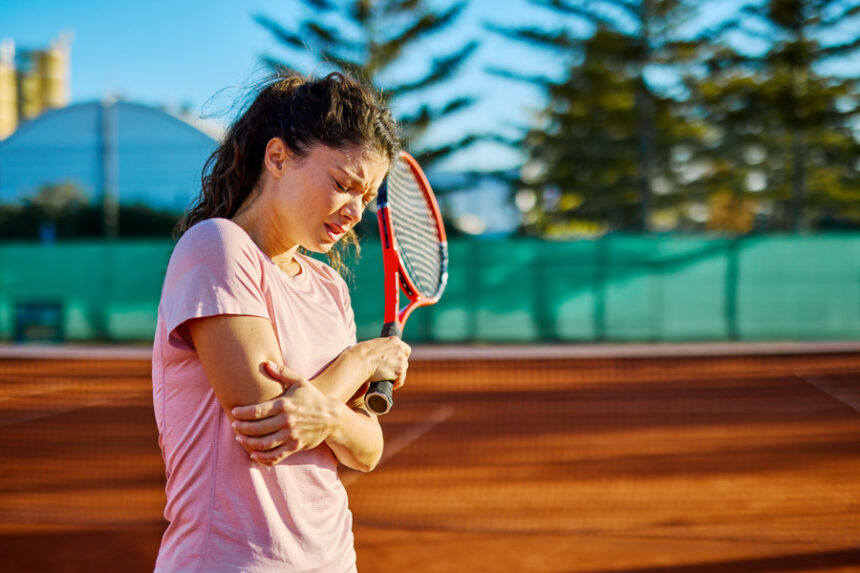
Think you’re safe from tennis elbow or golfer’s elbow because you don’t play either sport? Think again. These injuries are about repetitive motions, no matter the context.
“Tennis players with this injury are less common than you’d think,” says UNC Health sports medicine physician Anthony Garzone, DO. “Less than 5 percent of people with this condition play tennis.”
Tennis elbow, more formally known as lateral epicondylitis, is pain on the outside of your elbow. If the inside of your elbow hurts, that’s golfer’s elbow, or medial epicondylitis. With either condition, the pain can radiate into the forearm and wrist, affecting your ability to comfortably grip your sports equipment or do other everyday tasks.
Causes of Tennis Elbow and Golfer’s Elbow
You’re more likely to experience tennis elbow than golfer’s elbow.
“For every one golfer’s elbow I see, I see five to seven tennis elbows,” Dr. Garzone says, noting that tennis elbow affects 1 to 3 percent of the general population.
That’s because people are more likely to do repetitive movements that involve the outside of the elbow rather than the inside.
“When you extend your wrist or grip something, you’re using the extensor tendons that attach to the outside of your elbow,” Dr. Garzone says.
While playing tennis, you’re gripping the racket and using mostly those outside muscles. But occupational causes, such as repetitive manual labor, are more common. “It can be common in cooks, carpenters and plumbers. Weightlifting and typing also use this part of the elbow,” Dr. Garzone says.
The inside of your elbow is involved in your wrist’s flexion and turning motions, both important parts of a golfer’s swing, but racket sports and manual labor also may cause golfer’s elbow. (So yes, playing tennis could give you golfer’s elbow.)
For both golfer’s elbow and tennis elbow, you typically have to do the repetitive motion for hours each day. This pain is typically caused by overuse over the years.
“Both are seen most commonly in 40- to 60-year-olds,” Dr. Garzone says. “It affects your dominant hand in 75 percent of the cases.”
Smoking, obesity and diabetes are risk factors for tennis and golfer’s elbow because they affect blood flow to the joint. Improper equipment or bad form can cause these elbow injuries, but it can also just be repetitive movement.
Treatment for Tennis Elbow and Golfer’s Elbow
Tennis elbow and golfer’s elbow can both resolve on their own with time and rest.
“If you do nothing, 80 percent of cases will get better in one to two years,” Dr. Garzone says. “If your elbow hurts and you continue to do things, you won’t cause further damage, but it will continue to hurt. You need to decrease the load on the tendon and rest.”
That’s why your doctor will advise modifying the activities causing your pain, if possible. But if your job requires certain movements, that may not be an option.
You can ease acute pain with ice and chronic pain with heat, Dr. Garzone says, and oral and topical nonsteroidal anti-inflammatory drugs (NSAIDs) will help. A counterforce brace worn just under the elbow can help decrease the load on the tendon, and a wrist splint that immobilizes your wrist can help your elbow rest.
Your doctor likely will recommend physical therapy for both tennis and golfer’s elbow.
“With physical therapy, you’ll load the tendon in a gradual, progressive way, and this helps the tendon heal itself,” Dr. Garzone says. “There’s a focus on eccentric loading to strengthen the forearm.”
When you do strength training, concentric movement happens when you lift a weight toward you; the muscle contracts during concentric movement. Eccentric movement happens when you lower it away from you in a slow, controlled motion. Instead of contracting, the muscle will lengthen as it strengthens.
Most people feel better after some combination of these strategies, Dr. Garzone says, but for people with chronic cases of tennis elbow, there are additional options. Although corticosteroid injections may provide short-term relief, symptoms frequently recur.
Platelet-rich plasma (PRP) injections, in which a person’s own blood is drawn and spun in a centrifuge to separate out platelets, which have healing properties, have better long-term results. But these injections are not covered by insurance, so cost is often a barrier.
Another option is prolotherapy, in which a small amount of sugar water is injected into the tendon. This minor injury causes inflammation, which causes your body’s own growth factors to concentrate at the spot and work to rebuild the tendon.
Two newer options are extracorporeal shock wave therapy, which uses sound waves to stimulate the healing process, and percutaneous tenotomy, which uses a needle inserted into the tendon or high frequency vibrations to create microinjuries in the tendon to stimulate healing and remove damaged tissue.
“As a last resort, we’d consider surgery if you’ve done everything else and you’re not getting better, but only a small percentage of patients need that,” Dr. Garzone says.
How to Prevent Tennis Elbow and Golfer’s Elbow
You can prevent tennis and golfer’s elbow.
“If you’re doing something for longer than four hours a day, whether it’s sports or work with repetitive motions, make sure you have proper technique,” Dr. Garzone says. “Make sure you have a good ergonomic setup at work and the right equipment for your sport, with proper grip size.”
You may need to work with a coach or trainer to make sure your form is appropriate.
Be sure to include your forearms in strength training and stretching routines.
“Slow, controlled wrist exercises with a focus on the lowering phase help strengthen the tendons and build stability,” Dr. Garzone says.
Weekend warriors should be careful; while it’s tempting to play a full day of tennis or pickleball after a long week of work, that can cause injury.
“If you’ve been inactive, avoid that heavy load on the tendon,” Dr. Garzone says. “Work up to those longer durations. Listen to your body, and if your elbow hurts, stop.”
Experiencing pain? Talk to your doctor or find one near you.