The most contagious virus in the world, measles, has been surging across the United States over the past year, and now it is in North Carolina.
“Measles has been infecting people for thousands of years and before we had a vaccine, infected 2 to 3 million kids in the United States each year,” says UNC Health infectious diseases specialist David Wohl, MD. “With vaccination, measles was declared eliminated in our country. But over the past year there has been a resurgence of measles, with more than 2,200 cases in 2025. This is a direct a consequence of a drop in vaccination rates.”
In North Carolina, there were only 35 cases of the disease from 2005 to 2024. But in the first six weeks of 2026, there were 18 cases in the state.
“If only one person had measles, and everyone else was vaccinated, no one else would get it. But we have critical masses of people who are not vaccinated,” Dr. Wohl says.
Making matters worse is how infectious measles is. If a person with measles leaves a room, the virus stays in the air and on surfaces for two hours, Dr. Wohl says. Virus particles travel in the air across a room and it takes only a few particles to produce an infection.
Dr. Wohl answers common questions about measles.
What is my risk when there’s a measles case near me?
The measles, mumps and rubella (MMR) vaccine is given in two doses: one between 12 and 15 months old and a second between 4 and 6 years old. It is an incredibly effective vaccine, based on decades of available data.
“If you’ve had one dose of the MMR vaccine, you have 93 percent protection against measles,” Dr. Wohl says. “With two doses, you’re at 97 percent protection. That’s as close as we’re possibly going to get to 100 percent with a vaccine. If you’ve had two doses of the MMR and you’re exposed now, you do not need to worry.”
This vaccine provides lifelong immunity. While occasional cases happen in people who are fully vaccinated, they are rare, and even if they do get infected the disease will usually have milder symptoms.
If you only received one dose, you may want to consider getting your second dose now.
“If you had one, you can decide whether you want to go from 93 percent to 97 percent protection,” Dr. Wohl says. “If you have a job where you’re around a lot of people, that might be worth it to you.”
If you were born before 1957, you are also considered immune. Measles was so widespread at that point that everyone was exposed to the disease whether they had symptoms or not.
If you were born between 1963 and 1967, you may have received a version of the vaccine that was not as effective, so if you have not received an MMR vaccine since then, you may need another vaccination.
If you or someone in your family has not received the MMR vaccine, you are at high risk when cases are rising; in 2025, 93 percent of cases in the United States occurred in people who were unvaccinated or their vaccination status was unknown.
Should I get a measles titer test?
A measles titer test shows whether you have certain antibodies in your blood that would only be there if you received a measles immunization or had a prior infection. These tests are sometimes required for employment or school if a vaccination record can’t be found, but generally, people don’t need them.
“I’m not against these tests if you can’t find your records or you’re really unsure, but it’s easier to just get the MMR vaccine,” Dr. Wohl says.
The MMR vaccines are readily available at health departments or your local pharmacy, while getting a titer test involves visiting a healthcare provider, getting an order and having your blood drawn; there is usually a copay or out-of-pocket cost. If you don’t have appropriate immunity, you then get the vaccine.
Can babies get vaccinated early?
Dr. Wohl says the real concern is for babies under the age of 1 who have not yet received their first dose, which is recommended at 12 months.
Receiving the first dose before age 1 does not lead to lifelong immunity, but if you live in or are visiting a place with increasing cases of measles, it may be possible for a baby to receive a dose between six and 12 months. Talk to your child’s doctor about your concerns.
“Know what’s in your community and what’s in the places you’ll be traveling,” Dr. Wohl says.
You can track nationwide measles cases on the CDC’s website, and the North Carolina Department of Health and Human Services maintains a list of exposure locations by county.
If your baby does receive a dose before they’re 1 year old, they will still need two more doses, one at 12 months and one between ages 4 and 6.
What are the symptoms of measles?
Symptoms of measles usually appear seven to 14 days after an exposure.
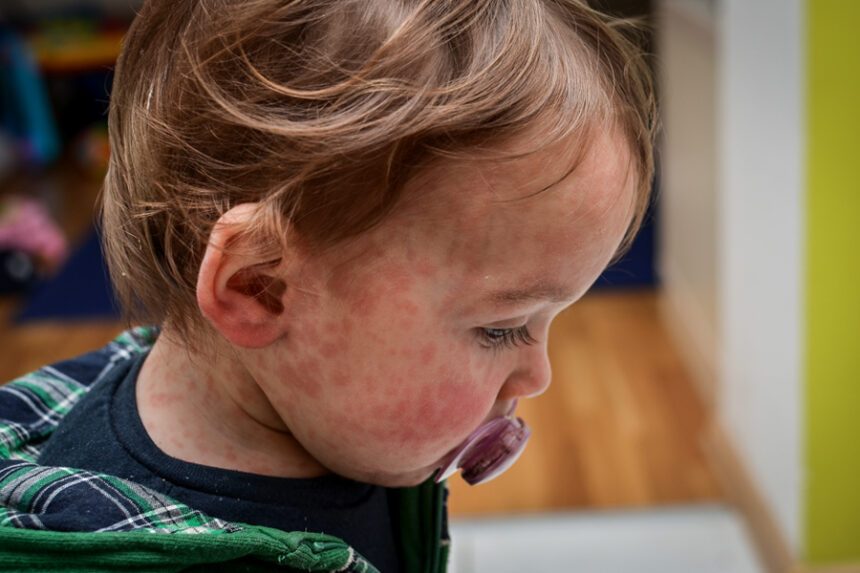
“It starts with a high fever, and this can be accompanied by red eyes, stuffiness and cough, symptoms that could be mistaken for the flu, COVID-19 or RSV at first,” Dr. Wohl says. “But then a red rash shows up. This rash starts at the head and works its way down to the trunk, while other rashes that children get tend to start on the trunk and go up.”
In children, measles can cause ear infections and diarrhea.
There is no treatment for measles, just support for symptoms. For people at high risk of getting very sick from measles, immunoglobulin therapy via IV or injection is an option after exposure to prevent severe illness. Talk to your doctor if you believe you have been exposed to someone with measles.
Most people will recover from the measles, but as with any disease, there are some people who won’t, and there’s no way to know ahead of time.
“In the cases in the U.S. last year, about 1 out of 10 people with measles had to be hospitalized,” Dr. Wohl says. “One out of every 20 children with measles will get pneumonia. Children can develop encephalitis, or swelling of the brain. Of 1,000 children who have the measles, 1 to 3 will die.”
Even if you don’t have brain swelling at the time of infection, it can show up years later, Dr. Wohl says.
What about natural immunity from getting measles?
Once you have the measles, you are immune to it, usually for life, but it can wipe out immunity you have to other viral and bacterial infections, thanks to a phenomenon unique to measles called immune amnesia.
“The immune system is rewired by the measles infection, so you are more likely to get other infections,” Dr. Wohl says. “Measles suppresses your ability to respond to other infections for up to three years. Studies find that more people die from immune amnesia than measles itself.”
Immune amnesia is caused only by measles infection, not by the measles vaccine, Dr. Wohl says.
Does vitamin A prevent measles?
Vitamin A does not prevent measles. Prolonged and excessive doses of vitamin A are toxic to your organs.
“It will not help to stop infection. Don’t do it,” Dr. Wohl says.
In countries where children do not have enough to eat and are malnourished, vitamin A may be given when a child has measles to help reverse deficiency as they fight the disease.
“When you’re malnourished, you are more likely to get severely ill from most any disease,” Dr. Wohl says. “Vitamin A corrects something that may be common among kids in other countries outside the United States where resources are limited.”
Is the MMR vaccine safe?
The MMR vaccine is safe.
In 1998, a British medical journal published a paper linking the MMR vaccine to autism; these results were found to be made up and false. There have been many large-scale and reputable studies since then, and no study has ever been able to link any vaccine to autism.
“We have decades of data that show the MMR vaccine to be a good, safe vaccine that works,” Dr. Wohl says.
If you’re concerned about exposure to measles, talk to your doctor. If you need a doctor, find one near you.