
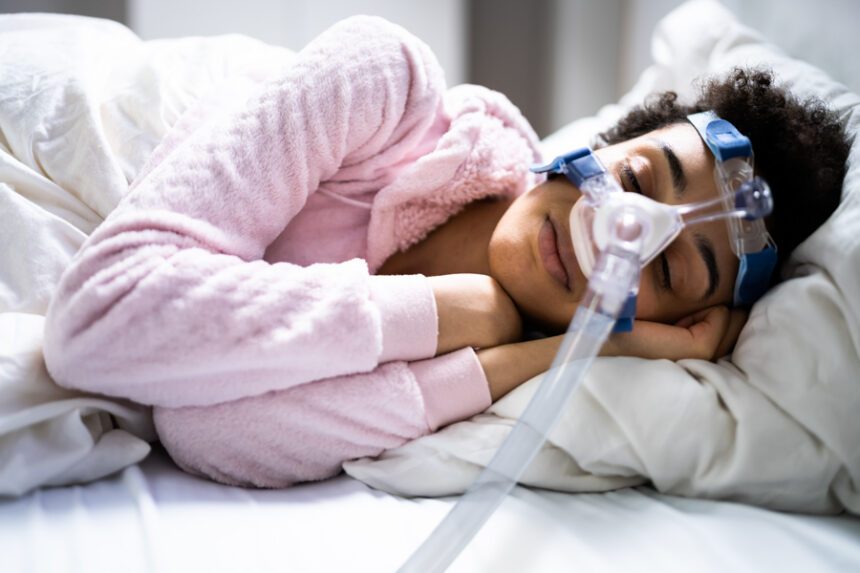
Two things are true of continuous positive airway pressure, or CPAP, machines: They can be life-changing in terms of your health and how you feel. They also tend to be a little tough to get used to.
This mask that you wear while sleeping delivers a constant flow of air, which keeps your airway open and triggers breathing from your lungs.
“If you can tolerate it, CPAP is the most effective treatment for sleep apnea that we have,” says UNC Health neurologist and sleep medicine physician Nathan Walker, MD. “There are other options, but nothing is as good as CPAP. That’s why it’s important to try really hard to get used to it.”
Sleep apnea, in which you repeatedly stop and start breathing during sleep, has both short-term and long-term consequences. You may feel tired every day, and it eventually increases your risk for high blood pressure, diabetes, heart attack and stroke.
It takes most people time to adjust to a CPAP, but there is a bit of a deadline: Most insurance companies will only pay for the CPAP if you use the device at least four hours a night on 70 percent of nights over a 90-day trial period.
“If you’re in that trial period and having problems, reach out to your provider, because it’s easier to try to help you now than later down the road,” Dr. Walker says.
Here are some common issues and possible solutions.
CPAP issue No. 1: You can’t sleep with something on your face.
There are more than 100 types of masks for CPAP therapy. Some cover your entire nose and mouth, some cover just your nose or your mouth, some just sit right under your nose to seal your nostrils. All of them have straps and connect to a hose that leads to the machine that administers the air.
The mask can feel claustrophobic at first.
“The mask is a huge distraction, so you’ll probably have problems if you put it on and immediately try to go to sleep,” Dr. Walker says. “Before you even attempt to sleep with your mask, just put it on and do something else for a little bit, like watching television or reading a book. Eventually, your brain will get used to the feeling.”
You want to try to wear the mask for long enough that you forget it’s there, the same way you may have become used to a new pair of glasses or a watch. Try to gradually increase the time you spend wearing it so that you’re able to tolerate it for longer periods.
Once you’ve gotten used to the feeling of the mask, turn on the air and try to get used to that sensation as well. With time, it will be easier to fall asleep with the mask on your face and the machine delivering air.
CPAP issue No. 2: The air is overwhelming.
Your medical provider will prescribe the pressure setting for your CPAP. But at first, the optimal level of air you need for effective treatment may feel like too much.
“Some people experience aerophagia, or the feeling that they’re swallowing air, when the pressure is too high,” Dr. Walker says. “It might feel difficult to breathe out against the air. We can adjust the settings to see if it helps.”
CPAP machines often have comfort settings such as ramp time, where air is first released at a low level, gradually building to full treatment pressure over a period of 45 minutes to an hour. You can also change the temperature of the air and the humidification settings, which might help if you’re experiencing dry mouth or other discomfort.
CPAP issue No. 3: Your bed partner is complaining about noise or air.
Modern CPAP machines are very quiet, the equivalent of an air conditioning unit or fan running while you sleep. They typically don’t bother anyone else. But the person you’re sharing a bed with may still have complaints.
“If someone is hearing bubbling or whistling, that’s usually a mask leak, when air is coming out of the sides of the mask,” Dr. Walker says. “Sometimes a blast of air from a mask leak can wake up a bed partner.”
Your provider will work with you to make sure your mask has a good, tight seal on your face, but it can take some trial and error. Facial hair presents an added challenge.
“Your face looks different awake than it does asleep, so you might have a good seal when you’re trying the mask on but not when you’re using the machine,” Dr. Walker says. “It takes some people a while to find a mask that is both comfortable and doesn’t leak.”
CPAP issue No. 4: It doesn’t seem like it’s working.
If you’ve been dealing with sleep apnea for a while, you may be eager for the therapy to give you a good night’s sleep so you feel less tired. That result may not come quickly.
“Some people do have the experience of immediately feeling better, but sleep apnea doesn’t always correspond to how sleepy someone is during the day,” Dr. Walker says. “You might have mild sleep apnea and be hardly able to stay awake, or you might have severe apnea and not feel tired at all during the day.”
You might actually feel worse in the first few months of using a CPAP, because your sleep can be additionally disrupted by adjusting to the mask. But even if you don’t notice any change in how you feel, other aspects of your health might be improving.
“When you treat sleep apnea, you might find that weight loss is easier or that your blood sugar is easier to control,” Dr. Walker says. “If you’re taking medication for high blood pressure, you might be able to go down in your dosing.”
With time, you may find that mood disorders such as depression or anxiety are easier to manage. A better night’s sleep can reduce your risk of cognitive impairment or dementia, too. Your risk for stroke and heart attack also will decrease.
“If you’ve been sleep-deprived for years, it might take a long time to start feeling better,” Dr. Walker says. “The more you use the machine, the better. There’s a world of things that treating sleep apnea can improve, but it takes time.”
If you’re struggling with your sleep, talk to your doctor. If you need a doctor, find one near you.