
In many ways, bees and wasps are good for our health. They pollinate the foods we eat, and a bee’s honey can be used as a natural remedy for coughs and colds. Wasps, a group that includes yellow jackets and hornets, eat some of the bugs that would otherwise eat crops or plants. If your mental health has ever been improved by looking at flowers and trees in nature, you have bees and wasps to thank.
Still, it can be hard to appreciate these insects when one stings you. Bee and wasp stings are painful, and for some people, they trigger an allergic reaction that includes anaphylaxis, a medical emergency.
We asked UNC Health family medicine doctor LeRon Jackson, MD, what to do if a bee or wasp sting has ruined your bee-utiful day. Here’s the buzz.
Symptoms and Allergic Reactions to a Bee or Wasp Sting
A sting can happen in a second, but the symptoms will last a little longer. You’ll feel pain first, followed shortly by itching, redness, mild swelling and redness at the site of the sting. That’s because the stinger contains venom, which kickstarts a chemical process in your blood.
That venom can cause some people to have an allergic reaction, which can range from mild to severe.
“In roughly 1 to 3 percent of the U.S. population, a sting can cause anaphylaxis,” Dr. Jackson says. “That’s when two or more body systems, in addition to the area where you were stung, are involved. The symptoms include hives and swelling in other parts of the body, dizziness, weakness, shortness of breath, an itchy throat and nausea or vomiting.”
For most people, the allergic reaction will be mild to moderate; you may notice hives or swelling. You can have an allergic reaction to a sting without being allergic to stinging insects, but consider it a warning. If you’ve had one allergic reaction to an insect sting, there’s a 25 to 60 percent chance that you’ll have a similar or worse reaction the next time you’re stung, Dr. Jackson says.
Caring for a Bee or Wasp Sting at Home
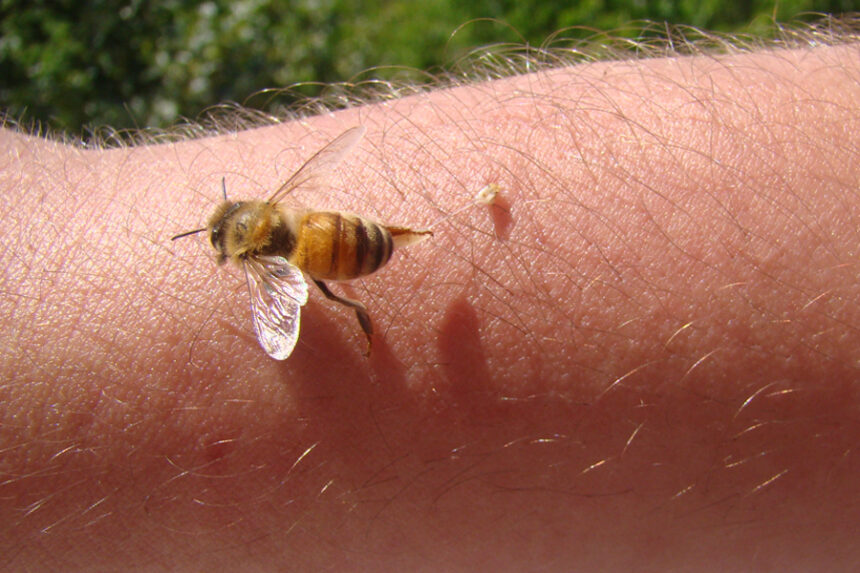
When a bee stings you, they leave their stinger in your skin (this is why they die after stinging you). Wasps keep their stinger.
“If you can feel the top edge of the stinger, run your fingernail, or something flat like a credit card, across it to dislodge it,” Dr. Jackson says. “Don’t squeeze the stinger with tweezers. It can cause the venom to go deeper down into your skin.”
If the stinger doesn’t come out, or you can’t see it, that’s OK. It may come out when swelling goes down.
Wash the area where you were stung with soap and water to prevent infection, and, “if you were stung on your finger, take off your rings so that if your finger swells, the ring won’t cause constriction, which could lead to a different medical emergency,” Dr. Jackson says.
Apply ice to the sting to help with the pain and swelling. You can apply a topical hydrocortisone cream or calamine lotion for itching and swelling. If needed, take an ibuprofen or acetaminophen for pain or an oral antihistamine to help with itching or swelling. Symptoms tend to resolve within a few hours, or, if there is a lot of swelling or hives, two to three days.
There’s not any evidence that other home remedies, such as applying tobacco or a paste made from baking soda to the sting, work to reduce pain or swelling, Dr. Jackson says.
When to Seek Medical Care for a Bee or Wasp Sting
If you start to experience the symptoms of anaphylaxis—symptoms at the site as well as at least two other symptoms anywhere in your body—you need to be treated with epinephrine. If you’ve already been prescribed an EpiPen (the most common brand name for an epinephrine injector), use it. If not, seek immediate medical attention at urgent care or an emergency department.
You should also seek care if you’re concerned about a moderate allergic reaction. Because of the risk of a more serious reaction with another sting, your provider may want to prescribe epinephrine for you to keep on hand or they may refer you to an allergist for testing.
There are other instances when you should seek medical care.
“If you’re stung multiple times, and then you feel really unwell in the 15 to 30 minutes after, you should be seen,” Dr. Jackson says. “It might be a reaction to the amount of toxin from multiple stings. Watch for dizziness, nausea and fatigue.”
If you’re stung in or around your eye or mouth, you should also seek medical care, because even mild swelling in those areas could affect your vision, swallowing or breathing.
Children have a lower risk for anaphylaxis from an insect sting compared to adults, but, “if you have any concerns with an infant or toddler who can’t speak for themselves, don’t hesitate to bring them in,” Dr. Jackson says.
If it’s been three days since you were stung and symptoms aren’t improving, see your healthcare provider.
Preventing Bee Stings
If you leave bees alone, they will generally leave you alone.
“Most bees aren’t going to sting unless they’re provoked, which happens when you swat them or when you get too close to their nest,” Dr. Jackson says. Unfortunately, wasps will sting unprovoked, as will Africanized bees (sometimes called killer bees).
If an insect is flying close to you, try to remain calm and avoid swatting.
It can be more difficult to avoid nests.
“We think of nests that are high, like in trees, but there are ground bees with nests underground, in decaying material like a log, or under decks and around siding,” Dr. Jackson says. “Be very careful when moving around debris or cleaning out a shed. People in landscaping or who ride mowers should try to wear long pants or sleeves in case they disturb a ground nest.”
If you know you’ll be outside, avoid strong perfumes, which attract bees and wasps, and watch out if you’re in a park or picnic shelter with open trash cans. If you know you’ll be in an area with tall grass, wearing closed-toe shoes can prevent painful stings on your feet.
Be careful when holding an open drink outside, especially if it’s anything other than water. The sweetness can attract insects, and you might take a sip and end up with a bee in your mouth.
If you inadvertently kick up a nest and are being chased by a swarm, try to put a solid barrier between you and the bees.
“There’s an old wives’ tale that if you’re being chased by a swarm, you should get in water, but some species will hover above the water and wait to sting you,” Dr. Jackson says. “Try to get somewhere indoors, or a place where you can close a door against a swarm.”
If a bee ends up in your car, try to remember driving safely is still the most important thing.
“Slow down, pull over, roll down all the windows and get out of the car if it’s safe to do so,” Dr. Jackson says. “Try not to panic with the bee in the car.”
Worried about an insect bite or a sting? Talk to your doctor or find one near you.